CIFF: "America the Beautiful"
By Rob Christopher in Arts & Entertainment on Oct 3, 2007 2:15PM
This is part of Chicagoist's continuing coverage of the Chicago International Film Festival.
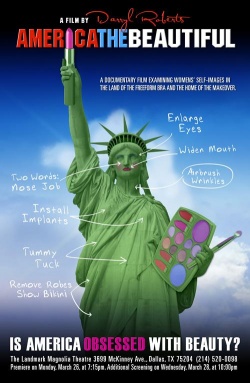 A sobering statistic from Chicago filmmaker Darryl Robert's new documentary America the Beautiful: Although the U.S. makes up only 5% of the world's population, its residents are exposed to 40% of its advertising. Roberts argues that one major effect of that hypersaturation is an obsession with a certain kind of "perfect beauty," an unrealistic ideal that leaves many women feeling unhappy with how they look and guilty about what they eat. His movie is a saddening but almost jaunty exploration of how this modern notion of perfect beauty took hold, who's being taken advantage of, and who's making money from it (as it turns out, an awful lot of people). He selects as his case study Gerren Taylor, a model who started on the catwalks at the age of 12 only to find that within a few years designers were already dismissing her for having "hips that were too big" and an unsuitable waist size.
Wisely, Roberts uses a low-key approach and lets his interview subjects do most of the talking. And as you can imagine, especially among people in the industry, there's a lot rationalization to go around. A woman at ad agency Leo Burnett explains with a straight face that there are two types of female consumers: "moderately beauty-involved" and "heavily beauty-involved." A designer reveals that the reason models with tiny figures are preferable is because dressing them uses less fabric, which is expensive. And, in an especially wicked jibe, Roberts points out that despite the fact that many Revlon cosmetics contain suspected carcinogens (which are are banned in the E.U.) twice a year the company sponsors breast cancer walk-a-thons.
Bottom line: it's definitely worth seeing. We guarantee a hearty post-screening discussion, and perhaps a new way of looking at trashy magazines with glossy covers.
America the Beautiful has a benefit screening on 10/6 and then screens again on 10/13 and 10/14. Details at the festival site.