Supreme Court to Hear Key Gun Case Today
By Kevin Robinson in News on Mar 18, 2008 3:00PM
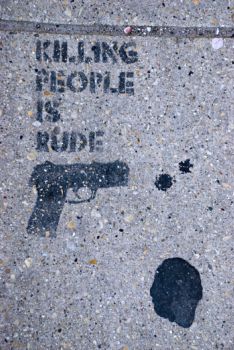 The Supreme Court will hear oral arguments today in Heller vs District of Columbia, the first major gun-rights case to come before the court in nearly 70 years. At issue is a long unresolved constitutional question: Does the Second Amendment protect an individual's right to keep and bear arms, or does it only protect a state's right to arm a militia?
Heller vs District of Columbia is the appeal of Parker et al vs District of Columbia, (PDF) brought before the DC Circuit in 2006. A key part of that case was the distinction between the individual right to bear arms, and the collective right to bear arms. That distinction flows from a 1939 Supreme Court ruling, US vs Miller, where the court ruled that Congress could regulate the purchase, ownership and transportation of firearms. The firearm in question in US vs Miller was a shotgun, and the government argued that that was not a military weapon. The court agreed, finding that since the states were charged with arming and maintaining a militia, the right to bear arms is held collectively, and Congress has no power to restrict a state's possession of firearms, but could regulate firearms that are not military issue from a state.
In Parker et al, the appellants wanted to possess handguns in their respective homes, and wanted to keep a registered shotgun assembled and unhindered, for self-defense. The District refused these requests, citing the city's gun ban, which made it all but illegal to possess or register a handgun or side arm, or to possess a loaded, assembled shotgun. In March 2007 the circuit court ruled that the Second Amendment grants an individual right to bear firearms, citing an earlier ruling from the Rehnquist Court, US v Verdugo-Urquidez, as precedent. Among the many issues settled in that case, the Supreme Court ruled that the term "the people" has a uniform construction throughout the Bill of Rights. Drawing from that conclusion, the DC Circuit ruled
"[T]he people" seems to have been a term of art employed in select parts of the Constitution. The Preamble declares that the Constitution is ordained and established by "the People of the United States." The Second Amendment protects "the right of the people to keep and bear Arms," and the Ninth and Tenth Amendments provide that certain rights and powers are retained by and reserved to "the people." While this textual exegesis is by no means conclusive, it suggests that "the people" protected by the Fourth Amendment, and by the First and Second Amendments, and to whom rights and powers are reserved in the Ninth and Tenth Amendments, refers to a class of persons who are part of a national community or who have otherwise developed sufficient connection with this country to be considered part of that community…. It seems unlikely that the Supreme Court would have lumped these provisions together without comment if it were of the view that the Second Amendment protects only a collective right….
This case is being watched closely across the nation, including here in Chicago, where the city's handgun ban is similar to DC's. Mayor Daley has made it clear that he supports stronger gun restrictions. The city, along with the Chicago Board of Education, has filed briefs arguing that, even if the court overturns the DC ban, Chicago's ban should remain untouched. Because DC is a federal creation, the city argues, the ruling should have no impact on Chicago. Benna Ruth Solomon, Chicago's deputy corporation counsel, told the Tribune that local communities should have the authority to regulate public safety. "Our City Council and mayor can be responsive to local residents," Solomon said. "And anyone who disagrees with the ban can find some other place to live."
Even if the Supreme Court rules that there is an individual right to bear arms, they will still have to decide whether the DC ban will stand, and how to evaluate gun control laws in other parts of the country.
Image via swanksalot