The Friday Flashback: Schwinn Quality, Made in Chicago
By Chuck Sudo in Miscellaneous on Sep 26, 2008 12:51PM
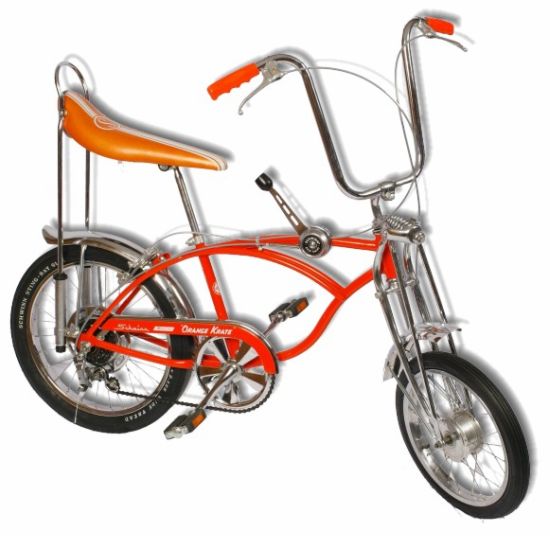
Ahhhh, the Schwinn Stingray. Our first real bicycle at 7 years of age was a Stingray in blue, with a five-speed gear shift on the top tube, banana seat, coaster brake, sissy bar and baseball cards fitted between the spokes. That Stingray sparked a lifelong love affair between the bicycle and us. Over the years we've saddled atop a seeming score of other Schwinns, including our current bike, a 2000 Mesa GS that's logged over 40,000 miles in eight years of riding.
 There was a time during the post-WW II boom period when one out of every four bicycles made in America was a Schwinn. Rolling out of a factory at 1718 N. Kildare on the west side, gleaming with chrome fenders, welds that could hold through an apocalypse and balloon tires designed to roll over rough terrain and broken glass with ease, Schwinns earned their reputation as the "Cadillac of American bicycles." With a lifetime warranty on their bikes unprecedented in the business, Schwinn backed up the claim.
The Arnold, Schwinn & Company was founded by German immigrant Ignaz Schwinn and Adolph Arnold in 1895. Arnold, who made his fortune in the meat packing industry, was the money man, Schwinn the designer. They eventually bought the factory on Kildare, set up offices at 1856 N. Kostner and started churning out bicycles. Schwinn also made motorcycles up to the Great Depression, when Ignaz's son F.W. "Frank" Schwinn took over the company and charted it on a bold course to separate the Schwinn brand from other bicycle companies.
Under Frank Schwinn's leadership, the company filed 40 patents, convinced tire maker American Rubber Co. to make the balloon tire for a smoother ride and added the detail aspects (the ersatz gas tank on the frame's top, chrome-plated headlights) that launched the beginning of the cruiser bicycle movement.
By 1950 Frank Schwinn hired Ray Burch as the company's sales promotions manager. Burch and dealer relations manager Bill Chambers pored through reams of distribution receipts and found that 27 percent of Schwinn's retailers sold 94 percent of their bikes. Knowing that they could get rid of three-quarters of their distributors with little effect on the bottom line, the research led to the formation of Schwinn's "Authorized Dealer" program. Moving Schwinn away from the department stores, dealers were required to carry Schwinn's as at least half of their inventory in showrooms that rivaled car dealerships. Dealers and salesmen were given extensive training in th brand, including bicycle construction and repair. The most successful dealers were offered group health care, bonuses and assistance in finding prime locations for new showrooms. Schwinn ads featuring the biggest stars of the day also added to the brand's cachet.
The Authorized Dealer program also signaled the beginning of the end for Schwinn. The company was sued by the Department of Justice in 1957 for restraint of trade and price-fixing. The case took ten years and went all the way to the Supreme Court, where Schwinn was found guilty. During this time, Schwinn launched the Stingray, and the Varsity and Continental series of ten-speed bikes.
By the 1970s, however, Schwinn had four regional warehouses in response to the Supreme Court decision and was unable to keep up with changes in customer tastes and advancements in materials, missing out on the BMX craze in the process. The company was slow to recognize that the industry was switching to lighter alloys for making bike frames, and profits dropped significantly. The final Schwinn rolled out of its west side factory in 1982. Eventually the Schwinn brand was purchased by Pacific Cycle in 2001. Although you'll find some Schwinns in bike shops, the brand is mainly relegated to the department stores Frank Schwinn shunned over a half-century earlier.
Chicago History Museum Reference for Arnold, Schwinn & Company.