When I look down at the grey, weather-beaten, splitting-wood platform beneath my feet on the Rockwell Stop, I wonder what relation to any one of the Powers That Be owns a lumber yard. Because it just seems silly that you'd rebuild numerous El platforms and stations, and then use untreated, unfinished wood planks that fall apart months after the grand reopening of the Brown Line station. And then I think about the months-long period of time where the automatic door openers at the stations were on the fritz, making the doors almost inoperable to open without mechanical assistance. And I wonder: What's the deal, CTA? Am I the only one thinking these thinks?
But then I read this story from the Chicago Tribune today, and I realize that I'm not the only person that's had the same concern. Jon Hilkevitch on the Getting Around beat finds rusting steel, corroding rivets, splintering boards, and other concerns on the brand new rail stations. These are the stations that are supposed to last us into the next four decades. Okay, so things are falling apart. The bigger question Hilkevitch asks is: did the city even need a revamping of the Brown Line?
Numbers and lamentation after the jump.
Hilkevitch writes:
The Brown Line provides only about 44,000 rides a day at stations north of the Merchandise Mart, according to the transit agency. Even counting the Loop elevated stations, Brown Line total daily ridership is about 68,000—a fraction of the almost 1.7 million rides* the CTA provides each weekday.
So it's not that the old Ravenswood Line needed more and larger trains all day - just during the rush hour period, which makes you think twice about spending a half billion dollars on the shiny new stations, which aren't as shiny or new as we'd like them to be. Nor did the CTA follow through on the promise that stations would remain open during refurbishing, as Paulina, Wellington and Irving Park riders certainly know currently.
While we will have full handicap accessibility on all platforms, which is worth noting, we still have no other upgrades like travel times for incoming trains, barely any communication on service updates, or other "perks" that might have brought the CTA into last century. Instead, we plod forward as though we're transportational Luddites, thrilled that they no longer use coal to power the carriages.
One small detail - the story reports that there's no heat lamps underneath the shelters at the Rockwell stop, which is true. Go outside during the upcoming winter months, and you will indeed freeze. But the heat lamps inside the station itself are more than warm, so don't worry too much about me and my fellow commuters at Rockwell and Leland. We'll be inside, wondering how much more snow and ice our platform can handle.
*In case you're curious, we did the quick math: 1.7 million riders X about $2 a ride X a full 365 days a year equals about 1 billion, 247 million dollars. Minus those freeloading seniors, of course.

Friday Afternoon Diversion: Earth With Rings


The new Rockwell: At least one door seems to be broken at any one time, though, I think, the puddles are no longer a problem on the new platform. Splinters are appearing on the platform. And one of the card machines seems to have problems nearly every week.
So, the old stations lasted 100 years, but the new ones are only good for 40 years?
Oh well, can't wait to see the splintering wood at Paulina.
Eh. Kimball is all concrete so we're holding up really well. We have plenty of covering and some heat lamps. Being at the end of the lines means I have a long commute but it also means I always get a seat (natch) which is pretty nice. So as long as Kimball functions as well as Roosevelt and/or State & Lake then I could concern myself less with the condition of the other stations.
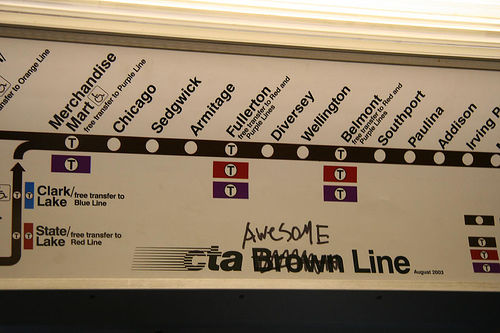
Oh, and as soon as the 3 tracks get back to 4 the Brown Line will definitely be the Awesome Line.
I just moved to Lincoln Square, and I love the Rockwell stop. Of course, I was using the Lawrence and Wilson red line stops before that, so I suppose I might just be biased.
So as long as Kimball functions as well as Roosevelt and/or State & Lake then I could concern myself less with the condition of the other stations.
Yet the condition of those other stations will affect how capital dollars are spent in the future, so it would pay to care at least a little bit. Everything is connected.
Damen is still closed as well. However we're getting cool vintage railings opposed to the 'punchout' metal squares of Montrose, Addison, Southport. etc. Damen was a pit, anything will be an improvement.
Frankly, I was shocked at the choice to use wood. And, in the downpour and waiting to transfer between the red and brown and Belmont, I did not the serious lack of coverage for commuters, as in none at all. Didn't the city think that limiting coverage would only cost more in maintenance workers having to shovel snow, deal with ice, and puddles. Not only will the wood condition worsen after each winter from being unprotected, but the lawsuits brought on by northsiders slipping on the ice will be costly too. My parents rooftop deck that they take really good care of needs wood replacement every couple of years.
The old stations were wood as well -- are you saying the CTA regressed in wood-based technology on the rebuilds? They couldn't afford a little Thompson's Weather Beater Sealant?
And, why question rebuilding the stations in general? Is your question, "Do we *really* need to accomodate handicapped people? Should we have spent our many on *that*?!" Because, that was the initial impetus for the entire rebuild.
I seriously doubt the CTA sprung for untreated wood, and purposely built these stations far below usefulness.
And, as far as the number of riders -- try taking a Brown Line train to or from downtown in the morning or afternoon rush. They're packed to the gills. So, either the numbers cited are wrong, or the ridership is completely abnormal. Either way, more capacity is needed..
The wood is just not good quality. I would be very curious as to who their suppliers were and the standards they were using. My best friend has made his fortune as a carpenter bringing decks and wooden porches up to code after the city cracked down following that horrid collapse a few years back. He's talked about how there are some very shady people supplying the trades in Chicago who also supply the city. God forbid one of those stations goes ass over tea-kettle with a train passing by...
Heh...I actually used to rent from the company that built the infamous collapsing porch, before I knew who they were.
Still, wood is wood -- it seems really unlikely the CTA would skimp *so much* that they would use untreated/poorly treated wood in their rebuilds. Wood isn't even that prominent in the structure of the stations, and they're spending tens of millions of dollars on each station. It just doesn't make sense..
In my profession I get to work with the forest preserve district of cook county. Recenty they were building a new learning center. After months of planning, ground was broken and construction went up.
It was only after 4 months did they realize that the walls were too thin to support the roof. A roof, whose timbers were already in place. If it had been allowed to finish, which it would have save for one person taking an extra measurement, it would have collapsed under the first snowfall. Hell, under the first RAIN.
Never underestimate the power of government work to FAIL
Time for some math corrections:
1. The Brown Line ridership stats do not include Belmont or Fullerton, two of the busier stations. The CTA can't tell which line people board, so they allocate 100% of rides to the Red Line.
2. Each ride costs far less than $2 on average. Transfers count as a separate ride and are only a quarter. Chicago Card users pay 1.75. Students pay less, as do handicapped. There are heavy monthly pass users lowering the average, and those freeloading moochers known as seniors ride free.
Privatization of the CTA now! With some government public interest controls this works great. Check out mtr.com.hk for a great example.
Sears: Privatize?
Sure.
Just a few questions:
1. What is the business model? That is, can you point to a major city mass transit system whose model you would like to imitate, or do you have your own model in mind?
2. What companies--that is, real, actual companies --might be interested in taking over and operating the CTA?
3. What would privitization do for fares?
4. For capital funds?
5. How would a newly privitized CTA avoid the woes that led the to the de-facto public takeover of Chicago's mass transit so many yeas ago?
6. As per Hong Kong, what do you think are the differences and similarities in relation to the CTA?
FYI: I've always asked anyone who proposed the privitization of the CTA similar questions, yet no one seems to even have the faintest clue about how to answer. I am sure you are different.
I wish the CTA would have used the rubber/plastic composite "wood like planks" that Metra uses on their Electric District platforms. Not only does this rubber/plastic composite material need little to no maintenance, it uses recyclable material.
Green materials for green transit.
I was just thinking to myself:
"Sears Tower, you need to prepare a comprehensive mass transit privatization plan for an organziation I don't work for, in a city I no longer live in, and make the first place I share it a blog whose posts are written more in fun than to imitate The Economist.
I should do this just in case someone I have never met before, and whose identity I will never know or want to know, takes the time to ask me a series of questions because he/she feels it is/isn't a good idea."
Sears Tower destroys the internerds and dances on their ashes. I tip my hat to you sir.
Sears: So, in other words, you really have no details about how to make the CTA private and better?
Great argument, sir. Way to advance the cause. I call bullshit on the idea, as no one I've ever met who supports making the CTA private can ever offer the faintest clue about how to do so. Way to wiggle out of supporting your idea by saying the blog is just "fun." You are the one who said privatize, cowboy.
In other words, I doubt you have the faintest clue about how to achieve your goal. (And I know about Hong Kong, too, and how that agency kind-of sort-of is privatized, but not really.)
Sears, Hong Kong isn't really privatized. We've been through this before--at least the internerds (Albany...you kill me with your wit!) have addressed this previously. MTR is only 23% privatized. Did you actually read the website, or did you hear that MTR was privitized somewhere and simply copy and paste the link? Just curious.
"The MTR Corporation was established in 1975 as the Mass Transit Railway Corporation with a mission to construct and operate, under prudent commercial principles, an urban metro system to help meet Hong Kong's public transport requirements. The sole shareholder was the Hong Kong Government.
The Company was re-established as the MTR Corporation Limited in June 2000 after the Hong Kong Special Administrative Region Government sold 23% of its issued share capital to private investors in an Initial Public Offering. MTR Corporation shares were listed on the Stock Exchange of Hong Kong on 5 October 2000."
Sears, you say privatization is the answer!, but don't really offer anything else to support why you say so or why it would work. That's like me proposing that magical elves on unicorns run the CTA. Instead of offering any answers to Matilda's questions, you mock them. Nice.
Sparky: MRT also has certain revenue advantages in real estate and retail that the CTA would not have were officials here to embrace even a semi-private structure.
But what do I know? I've just talked to some MRT executives over the years about this very subject for my job. No, that does not make me the ultimate expert, but I do have some grounding in this subject that Sears, judging by his/her comments, seems to lack.
In any case, simply shouting Privatize! without offering any details about how to do such a thing is unlikely to lead to any change at all, even over the long-term. But hey, the whole point seems to be merely to shout to oneself, right, and not change any minds*?
*by the way, I would love for advocates of privatization to change my mind, to make me see how even a semi-private structure would improve CTA's mass transit. At this point, I am willing to do nearly anything to get improvements. But that's impossible without detail or fully-formed ideas.
In any case, simply shouting Privatize! without offering any details about how to do such a thing is unlikely to lead to any change at all, even over the long-term.
Is the shouting of Privatize! on Chicagoist while providing viable details expected to lead to change?
Change often comes from changing individual minds in the long term, don't you think? (That is one reason why mainstream American is much more accepting of gays than in the past, at least in my view. As well, it has taken a lot of work to educate citizens on how this city abuses TIFs, and this happened because one reporter in particular kept providing details.) In any case, details are always better than an empty slogan, which is a substitute for thinking.
Well, Bunny, yes this is Chicagoist, but I know for a fact that there are other sites and people that pay attention to what goes on here. CTA Tattler and Beachwood Reporter, for example, will link to this site. I also know that there are people within the CTA and the city that pay attention to this site, and other sites as well. Ron Huberman has told me (yes, I have had the opportunity to speak with him) that he visits CTA Tattler when he can (he especially likes the Flickr photos).
So, while shouting Privitize! may without providing detals may not lead to change, it could. And anyway, why can't we have some solid discussion? Sure, this may only be Chicagoist, but why insult each other's intelligences?
I have yet to understand the use of untreated pine on the platforms. The CTA is spending millions replacing old wood railtoes with the new composite ones. Composite decking would have been a much better choice, and while it is more expensive, it takes much less maintenance, and lasts many times longer than untreated wood.
As for privitization, I'm not sure even privitizing the CTA will get it to where it needs to be, especially considering the amount of infrastructure upgrades that still need to be attended to.
What I'm more an advocate for, is the CTA and RTA opening their books to be a matter of public record.
Just to clarify, I am in favor of privatization. I don't know what privitization is, but everyone seems reasonably intelligent here so maybe the word isn't mizzpelllt.
Why do people against change demand a detailed plan for evidence, yet offer none of their own for their cause? Weird.
If you think paying $2.25 a ride (just wait) plus 1.25% sales tax to use a half broken down system that is good for getting downtown and points directly N/S/E/W of wherever you are is a good thing, I don't think anyone can sell you on non government controlled services.
Why do people against change demand a detailed plan for evidence, yet offer none of their own for their cause? Weird.
Because if there are no details, how can we decide whether the change will be good or better? Fucking duh. And the system was private, so one would be wise to tell how we will avoid the mistakes that doomed the first effort at privitization. You've offered no specifics about how a private system will be better. All you offer is some vague feeling that it will be better. Sorry, but more is needed. Again, fucking duh.
I support a public system with 1) More dedicated and stable funding from the feds (transportation budget for mass transit operating costs; capital funds from an infrastructure bank); 2) Leaner operations for the CTA (cut more managers and hacks; reform the pensions even further if possible to match more closely the situation in the private sector; service cuts and realingments where applicable) 3) Higher costs to park and register cars and trucks, with the money going to mass transit; 4) More money for mass transit in the next state capital works budget; 5) Higher fares for local mass transit, especially for cash fares; 6) Higher gas taxes, with the extra going to mass transit.
How about a roof on the new platforms- are roofs no longer in style? As the sun and rain beat down on the platform they will need real maintenance in maybe 5 years.
I believe the El was originally private (built with govt funds of course), but then it went bankrupt and was taken over by the city. Lets run through that cycle again.
What government run enterprises need is more accountability- people who mismanage things need to get fired or demoted. There has to be an opportunity to get paid in relation to your productivity. That is what private enterprise supposedly brings to the equation.
The problem is how do you introduce competition into a public service? Do you want 4 different train lines or bus services running down the track/street. Privatization without competition is just a monopoly- which is worse than government management in my opinion.