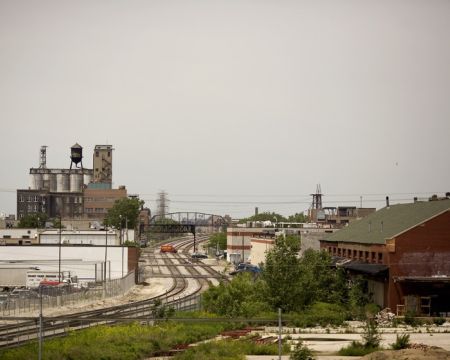
While the U.S. Senate was debating the American Recovery and Reinvestment Act, the bill that President Obama hopes will pump billions of dollars and thousands of jobs into the faltering economy, the White House released a study indicating that the bill could save or create 150,000 jobs over the next two years. According to Crain's Chicago Business, those estimates "are based on the overall goal that the plan will create or save 3 million to 4 million jobs nationally over the next two years." (You can check out per capita details of the House stimulus plan over at the Wall Street Journal's nifty "Who gets what" map.)
While the bill faces opposition in the Senate, a provision in the bill that would require iron and steel used in construction projects be manufactured in the United States is raising eyebrows overseas. The European Union's delegation to the United States issued a statement warning that such provisions may be viewed as "protectionist" and that inclusion of such a clause in the bill may result in the US being brought before the World Trade Organization. The WTO, which succeeded the General Agreement on Trade and Tariffs in 1995 is responsible for policing global adherence to free trade agreements. Obama says that he wants to make sure any language in the final bill doesn't signal protectionism. "I think it would be a mistake though, at a time when worldwide trade is declining, for us to start sending a message that somehow we're just looking after ourselves and not concerned with world trade," he said in an interview with Fox News.
Manufacturing (excluding durable and non-durable goods) employed over 650,000 people in Illinois in October 2008, (the latest month that numbers are available from the Illinois Department of Employment Security), and the Council of American States in Europe notes that primary metal manufacturing and fabricated metal product manufacturing employs over 125,000 people in the state.
Photo by Cycle the Ghost Round


One thing Obama needs to do is beat back the protectionist wing of the Dem party--not an easy task these days, but important to the long-term economic growth of the US and many other countries. Sure, there is something to be said for negotiating trade deals that are more, uh, well "fair," I guess: Better labor protections, for instance, and better environmental protects, and provisions that don't allow other countries to take advantage of us through practices that amount to flooding the market with loss leaders. Increased protectionism harms the Caterpillars and such, I think, and we don't want that, despite what some union people say.
What's funny is how so many blue-collar conservatives, unlike the situation in the late 1970s and 1980s, when they supported Buy American efforts, are now in the other camp, at least according to their political representation.
In any case, if this stimulus bill is done right, I think the US steel industries and some related industries will come out alright. And we don't need a full-fledged trade war on our plate right now.
Your headline is perfect, except that one word is missing. It should read "Stimulus Bill May Mean LESS jobs for Illinois."
I call it the De-Stimulus Package because it will have the opposite effect of that intended.
Government spending, drawn from government borrowing, prolonged the Great Depression. It didn't work in the 1930's and it won't work now. The "New Deal" was a bad deal.
Let the markets correct themselves. Let the weak businesses fail. Sounds mean, but it isn't. Not if you want people to have more jobs at better pay in the long run. Let the marketplace determine workforce needs. That will lead to the greatest prosperity for all, especially for the neediest in our society.
Propping up failing companies sounds nice, but it actually is harmful to any particular industry and to society as a hole.
Our recession will thus be prolonged and our children's generation will be saddled with more federal debt. And yes, the federal debt does have a harmful effect. Our children will explain that to us when they are hurt by it.
Ward, the word you're looking for is fewer. :)
"Government spending, drawn from government borrowing, prolonged the Great Depression. It didn't work in the 1930's and it won't work now. The "New Deal" was a bad deal."
There are a good deal of experts who disagree, and who have the stats to back up the idea that FDR's attempts to cut govt spending in the mid-to-late 1930s actually contributed to the second phase of The Great Depression that lasted until 1940-1941. Don't believe me--research it. It's not that hard to look up either on Google or (better yet) at the library. Have you done the proper homework on this issue?
I share you concerns about the federal debt--don't get me wrong. But sooner or later we will have to pay for infrastructure and health-care reform of some sort, even if there is no universal health care. The current system simply isn't working.
Even Milton Friedman could be an idiosyncratic Kenysian at times.
Indeed Matilda,
The same kind of people who trot out, with complete certitude that FDR bogeyman business, are the same people who consider economics to be a hard lab tested science. At least it usually seems that way.
As for how we've chosen to create our debt, let's see which is better for us in the long run:
Two wars with no end in sight.
Or
Investing in jobs and improvements in our own dilapidated backyard.
Ward,
The problem with your "Let the market" correct itself argument is that we unfortunately live in a real world, not a make believe Libertarian fantasy world that won't collapse into hell if we just let the market regulate itself. That kind of thinking's exactly why we're in this mess now. As for the financial houses it's all too late thanks to the non-transparent handouts of and lack of oversight by fellow 'free market' Republican posuers like Bush, Alan (oops my Friedman-ian ideology was a sham)Greenspan, Chris Cox and Hank Paulson. We need a stimulus plan for sure, but one that's actually got some teeth to it, half steppin' and no money for stuff that's not certain to create jobs.
I will give you props for deviating from the usual "tax cuts to the wealthy" will stimulate job growth canard.
Navin, we're in this mess right now because both sides of the aisle's politicians are incapable of making good decisions for our future if it means that they have to take heat in the short-term.
This "stimulus plan" is hardly that - let's just call it what it is - "the democratic party agenda plan." I'm not going to act like the Democratic Party is alone in this, because the Republican Party has and would have done the same.
Oh you'll get know argument from me about the Democrats Jimbo, they're the one's who cowered in the corner while the Bush administration fiercly pushed their agenda. But the Bush administration were hardly the one's who started it, that would begin with everyone from Reagan to now (Clinton) included. Financial "titans", "geniuses" and failed free market ideas...
We're all going to pay now thanks to these ideologues.
Agree 100%. Actually, go back to Reagan, too, or even LBJ if we want to talk about long-term debt and entitlements. We are going to be eating a shit sandwich for probably the next 2-5 years because of our nation's stupid ways over the last couple of generations. And we likely will have to revisit our concepts of growth after the economy picks up.
I urge you all to read this Sunday's NYT Magazine cover story--the Big Fix--to get some other views about what the Obama Administration faces and what it is trying to do. Everyone will learn something, and the article talks about issues that none of can ignore.
I wish the stimulus has much more infrastructure and health-care reform spending, to be honest. If we are going to spend so much--and make no mistake, we will, thanks to Dem control--let's spend on some good things.
I would give more credibility to the GOP at this time if they had any read ideas beyond tax cuts, tax cuts, tax cuts (even if I do agree the corporate rates need to be cut in certain ways.) The GOP has been coasting on that idea for some 30 years now, and it's simple minded and ideological, not pragmatic.
Lastly, free market my ass. No such thing for the time being. Capitalism, at for now, has choked itself--and I hate sounding like a Marxist.
"....Lastly, free market my ass. No such thing for the time being. Capitalism, at for now, has choked itself--and I hate sounding like a Marxist...."
Capitalism isn't to blame for the current mess. Quite the opposite is true.
It was the meddling by politicians, responding to pressure from activists, who interfered with capitalism. Banks and other institutions were forced and/or incentivized to make countless high-risk loans. There are other reasons for the meltdown, but too-much-capitalism is not one of them.
That's a wonderful idea, up there with the tooth fairy and clean government in Chicago.
From time to time, capitalism, like economic systems, reaches a choke point that requires correction. Banks and other insitutions were hardly "forced" to make these high-risk loans, assertion that is at odds with documented facts--seriously, do your homework. Financial institutions and groups, whether traditional banks or investment banks or hedge funds or whatever, eagerly bundled various loans, including subprime mortgages, into securities that were sold and repackaged and sold again, based on various mathematical models and theories. Again, this is fact. No one in the government--certainly not those evil libs--forced Bank of America or Lehman or Citi or whomever to engage in this giant pyramid scheme. If anything, these companies were encourage to do so by a series of deregulatory moves that date back to the Clinton Adm and which were continued under Bush. Again, this is fact. You can look up the history if you want. Hell, all you need to do if you don't want to do much is read the WSJ or Financial Times. Consumers certainly deserve blame for overspending and refinancing beyond their means, but to blame this crisis on too little capitalism is like insisting, into your adult years, that Santa still swoops down from the North Pole early ever winter to deliver your "Libs Are Commie Fascists" workbook to your stocking with care. No, ACORN and its ilk did not cause this crisis, though some of these groups, backed by the influence of Fannie and Fredie, certainly encourage irresponsible borrowing and lending.
Seriously, Ward, do some homework beyond listening to various right-wing propagandists. Facts can be your pal.
Give me what you're smoking Ward,
Yeah financial hot shots were forced to make ga-jillions off of a ponzi scheme of "complex financial instruments". You've got to do better than parroting Rush talking points that you don't understand.
No one forced them to make those loans. It was sheer greed.
And it was greed that made people want to keep up with the Jones/Johnson/Rodriquez/Lee families and buy houses they couldn't afford, buy flip properties to "make an easy buck" run up credit card debt buying crap we really don't need. What's even worse is that some banks insiders (ie: WAMU) knew they were rolling craps years before all of this happened and warned people, but some wanted the gravy train to keep right on rolling.
As Gordon Gecko once said "Greed is good." Except when it isn't.
What will happen to these wonderful jobs when the stimulus money runs out? Will the economy need to be stimulated again?
If this is done right--and that's a big, big if--the spending would help spark demand and the establishment of new areas of industry and service, sort of like the canals and railroads and interstate and Internet did, though not exactly. The idea is to give the economy a jolt--certainly a huge jolt by historical standards, but a jolt nonetheless. I think you ask a great question. Will it work? Who the hell knows. But Kenysian economics has provided benefits before, and I am more willing to take the gamble on spending than some tired idea of tax cuts, tax cuts, tax cuts that hardly work as well as backers claim (Reagan years left us with massive debt, for instance, and more distance between rich and poor.)
Seriously, ready that NY Times Magazine piece if you haven't already. The article does address that question directly and indirectly, though conclusions are vague.
"If this is done right"
You're right, that is a big if. If it's done wrong, we're all stuck paying for it. If it's done right, we're still stuck paying for it, but with a slightly larger tax base. I'm not holding my breath.
Which article are you referring to? I didn't see it linked above.
It's not linked above. You have to look it up yourself. I would guess it's still available through the New York Times Web site.
Listen, we are stuck paying for this mess one way or another. Say there is no stimulus and unemployment rises. Taxpayers are on the hook for jobless benefits; pensions in some cases and health care. And tax revenues remain low as growth takes longer to kick in. It's a gamble either way, but I prefer the Kenysian path at this point.
So Illinois gets 150,000 jobs out of this. When you consider that there are CEO's getting between 50 to 100 million dollar a year pay packages, and think about the bonuses
that some of these bankers got AFTER they got bailout money this past year...all combined it would probably be more than what the beneficiaries of these 150,000 job owners will get.
Talk about greed...these jerks don't care about the future of the company (or the little people making that company function) when all they have to do is put in a few years and then land softly with their golden parachutes. I've seen this up close and personal with the biggest ad agency here in Chicago, which used to rule the world and is now in the shit hole because of this kind of attitude.
Nobody can predict one way or the other what is going to happen with this stimulus package because you cannot predict human behavior. Human behavior is what got us into this mess and hopefully it will get us out. Hopefully.
I see Obama making earnest efforts, which is a lot more than you can say about his predecessor. Everybody and his cousin has an opinion of how right or wrong this stimulus package is, but it all boils down to what we as a nation are going to do about it.