AP Claims Iconic Obama Poster Is "Copyright Infringement"

2009_02_05_obama.jpg

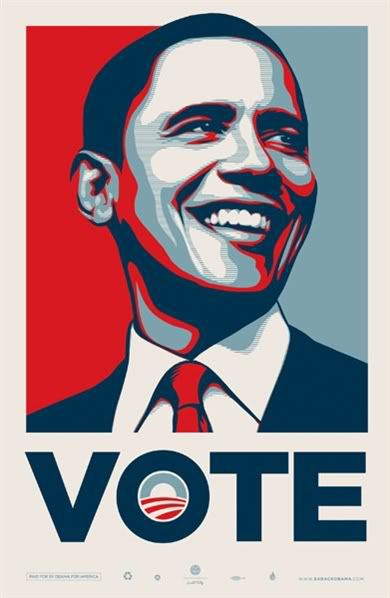
Left: AP Photo/Manny Garcia, Right: "HOPE" poster by Shepard Fairey

Remember Shepard Fariey's iconic HOPE poster featuring now-President Barack Obama? Of course you do. They're still featured on banners hanging from various light poles across the city. It was one of the most popular campaign posters in recent memory but now the Associate Press wants monetary compensation and credit for what they believe is a case of copyright infringement. Fariey has conceded that the likeness of Obama on his poster is based on an AP photo taken at the Washington Press Club in 2006 by photographer Manny Garcia. In a statement, the AP said:

"The Associated Press has determined that the photograph used in the poster is an AP photo and that its use required permission," the AP's director of media relations, Paul Colford, said in a statement.

"AP safeguards its assets and looks at these events on a case-by-case basis. We have reached out to Mr. Fairey's attorney and are in discussions. We hope for an amicable solution."

Fariey disagrees and his attorney responded in a statement:

"We believe fair use protects Shepard's right to do what he did here," says Fairey's attorney, Anthony Falzone, executive director of the Fair Use Project at Stanford University and a lecturer at the Stanford Law School. "It wouldn't be appropriate to comment beyond that at this time because we are in discussions about this with the AP."
Interestingly, the AP story on case calls Fairey "A longtime rebel with a history of breaking rules" and cites an unnamed Obama Campaign source as saying the campaign never officially licensed the image for the campaign and, in fact, later asked Fairey to do another version of the poster using a picture the campaign had rights to, which he did. Twice. Fairey maintains that he hasn't profited from the poster, but it's obvious someone has, so the AP wants its share of the money.
Email This Entry


Comments (21) [rss]

Photo: Blue Tie
Graphic: Red Tie
red ≠ blue

case closed.

This is pretty damn ridiculous. Even if he based the poster on the photo, it's different enough not to be infringement. It's not like he took the photo, typed HOPE on it in Photoshop, and sent it off on its merry way.

Hey AP -
I haven't seen a stretch like that
since Spiderman quit my Yoga class!

hey AP, look up the term "FAIR USE"

This is clearly an attempt to encroach on and weaken the concept of Fair Use and as far as I'm concerned they can go pound sand.

HOWEVER
Fairey has a history of sending C&D to other artists who appropriated the andre OBEY stuff in a parodic fashion. So, I hope AP loses the case but only after Fairey is bankrupted somehow.

When Fairey was on Colbert he mentioned he hadn't made a penny from the poster and Colbert was astonished.

Actually, I don't think this qualifies as fair use, at least to the Obama campaign (campaigns have been ordered to stop using copyrighted songs, after all) and to those who did, in fact, profit from the image. And running a photo through photoshop isn't enough to claim that photo as yours.

This reminds me of an incident in my native Kentucky. In 1985 or so, the state issued license plates that featured a graphic of two horses, mother and foal, running side-by-side, so that the smaller horse seemed contained within the larger horse. I always thought it was a simple, classy-looking plate. Sometime in the '90s, though, a photographer sued the state, claiming the image was based on a photograph he took. The photographer won, and rather than pay royalties the state canned the plates, switching to first some God-awful cloud patterned background, and then an even worse Teletubbie sun.

BlueFairlane,

Whatever anyone thinks about Shepard Fairey's work, he does not just run a photo through photoshop. His work tends to be stencil and paint based. More importantly, if you really look closely at the two images, there are a number of minor differences (like the angle of Obama's head)in addition to the different colors and backgrounds. Besides just think of all the artists (Warhol) who appropriate or are inspired by other images.

Also, there are specific characteristics that are considered when determining fair use: 1. purpose and character (is the work transformative, is it being used for non-profit or education purposes); 2. nature of the work (does the work have social value that trumps private ownership); 3. amount (how much of the original work is incorporated into the secondary work); effect upon value (does the secondary work devalue the original). On counts 1, 3, and 4, I think Fairey has a good case.

Regardless of how complicated the process Fairey uses may be, he still is basing his work off an existing photograph without permission of the individual who took the photograph. The process does not make the work his.

Nevertheless, to be clear, I agree that Fairey would have a good case were people not profitting off the work. It's irrelevant whether Fairey himself has profitted. I would think the AP would be better off going after whoever is making money off the work rather than Fairey himself, but I think they'll get traction with this one.

I have to disagree with you, BlueFairlane. Yes, it's the same pose and angle and the guy even admitted he based his work off the AP photo - but that doesn't mean he violated AP's copyright.

Does the AP have a copyright to all pictures of Obama in that pose? Does the first guy to take a picture of The Bean from a certain spot get a copyright on all pictures like that, and paintings like his picture? Of course not. The AP's copyright is for that one picture, and nothing else. This isn't even the same picture - yes, same angle, pose, based off it, etc. But Fairey transformed it into something else, and that is why the AP's claim is bogus.

To be clear, I think Fairey loses some originality points for cribbing off the pic, although that does not make him into an infringer.

This isn't really debatable, as Fairey has admitted he used the photo. If Fairey wanted to take a similar photo himself, that would be fine. Or if he wanted to use a similar photo with permission of the owner--say, the campaign, which he in fact did do--that also would be fine. No, the AP does not hold copyright on all similar photos ... just that one. Which by his own admission, Fairey used.

Again, I think it all depends on how much he used the photo. Seeing the photo, and making an image based off the photo, is fine as far as I am concerned. Even if he had taken the picture, and photoshopped it up - which I don't think he did - it still might be okay. Even though he saw the pic, and based his work off it, the AP shouldn't be able to say that is their picture. It's too strict of an interpretation to say otherwise.

But the key is that this isn't about what's fine as far as you're concerned, but what's fine as far as the law is concerned. Copyright law does not allow the copying of other people's work, regardless of whether you change the medium, regardless of whether you change certain aspects of the original. It still is using another person'd work.

And again, this wouldn't be as much of an issue were it simply a matter of artistic license, but as I've said, people have profitted off this. As such, AP deserves compensation.

Blue,

It absolutely is debatable. Yes he admits to using the photo for inspiration, but he significantly altered the content. By making changes to the color, angle, and media used, he transformed the contents of the photo into a new and distinct work, with a different intent and message than the original work (which is a factor in determining fair use).

Let's think about Warhol. Warhol used other people's photographs (for which he did get sued at least once and settled out of court) and products (campbell soup cans, brillo, etc), but transformed them into something else. Artists use copyrighted images and objects all the time in their work. One of the reasons behind fair use laws is to prevent copyrights from smothering artistic endeavors, which is exactly what the AP is doing.

So why did Warhol settle out of court? If his altered reproductions of the orginal image made the image his, why didn't he press the matter?

It's called Fair Use, and the AP don't have a leg to stand on. According to the case Campbell v. Acuff-Rose Music, Inc.:

[If] the secondary use adds value to the original--if the quoted matter is used as raw material, transformed in the creation of new information, new aesthetics, new insights and understandings--this is the very type of activity that the fair use doctrine intends to protect for the enrichment of society. Transformative uses may include criticizing the quoted work, exposing the character of the original author, proving a fact, or summarizing an idea argued in the original in order to defend or rebut it. They also may include parody, symbolism, aesthetic declarations, and innumerable other uses.

As DailyKos says, "How the AP can argue that use of this picture hasn't been transformed by Fairey to offer 'new information, new aesthetics, new insights and understandings' is beyond comprehension."

Again, the issue isn't the transformative use of an image for the enrichment of society, which I do believe was Fairey's original purpose. It is the fact that people--not Fairey, but others--made money off it, which is outside the protection offered by Fair Use. The big question in my mind is whether AP can hold Fairey liable simply for creating the image, or if they will have to go after those who profitted.

I have spent far too much time searching -ist archives for a story I think I read on LAist a few months back, which I think correlates. If memory serves, a photgrapher had taken artistic images of graffiti, which she then placed in a show. Through her photographic process, she altered the medium, the angle, the method of presentation, and other factors, but she did not credit or seek permission from any of the graffiti artists. During her show, she sold many of her prints, making a profit in the neighborhood of six figures (I don't recal the exact number). The graffiti artists sued, and she was forced to close the show. I don't recall the outcome of the lawsuit, or whether it was even decided at that point.

So, assuming my memory of the post is not faulty, would you say Fair Use should have covered the photographer?

Profit is just one factor to consider when determining fair use. It is not the deciding factor.

The photographer SHOULD have lost - that was a photograph of the graffiti. It incorporates someone else's artistic work. Again with the Bean analogy, this is why people aren't allowed to sell pictures of the Bean. But, Fairey isn't doing that. It isn't a copy of the picture. I think what is getting Fairey in trouble is that he admitted to using the picture. It still doesn't make it a copyright infringement.

Not only is this what I personally believe, it is my interpretation of the law. He didn't simply "take" the picture - he used it, if anything, as a basis for his own rendition of Obama. As others have said, there are differences between the two images beyond the color scheme. While I see your point, it simply should not stand to reason that Fairey infringed the AP's copyright.

You'll have to ask him. Maybe he wanted to avoid trouble who knows. As far as I know this the only time he was successfully sued for copyright infringement - considering most of his works were based on copyrighted images or objects, this is remarkable. Campbell's sued him as well, but they dropped their lawsuit when they saw how his work was actually benefiting them. Warhol's work gave Campbell's free publicity much like Fairey's work is giving AP publicity and is actually increasing the "value" of the original work, not detracting from it (this by the way is an element of fair use).

My point is that according to your ideas of fair use and copyright there are museums full of art by countless artists that are violating copyright. Fair use exists to give people the room and tools to express themselves creatively and to use works for educational purposes. Warhol's and Fairey's work are perfect examples of fair use and why fair use is an important legal principle.

I don't think this is anything new.
http://www.supertouchart.com/2009/02/02/editorial-the-medium-is-the-message-shepard-fairey-and-the-art-of-appropriation/

Post a comment (Comment Policy)

Tips

About Chicagoist

Chicagoist is a website about Chicago. More

Editor: Marcus Gilmer
Publisher: Gothamist

Contribute

Latest Tip:

NYT article detailing how the city will spend all of the money from the parking meter lease by 2010.
[more]

Latest Photo:

Recent Comments

Subscribe

Use an RSS reader to stay up to date with the latest news and posts from Chicagoist.

All Our RSS