We may have lost the Olympics and all the construction/repairs that come along with it, but to nurture our souls we can look to a brand new interstate! According to the Chicago Tribune, a recent study indicates a potential need for a new interstate linking Illinois and Indiana due to increasing traffic rates. The proposed interstate, dubbed The Illiana Expressway, could cut congestion significantly along with providing a surge to the region’s economy. The proposed 25 to 30 mile stretch, operating as a tollway, would connect I-57 in Will County with I-65 in Lake County, Indiana and would cost as much as $1 billion.
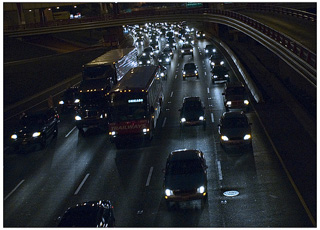
According to the study, conducted by consulting firm Cambridge Systematics Inc., I-80/94, I-90 and U.S. Highway 30 carry a combined 216,000 vehicles a day across the Illinois-Indiana border. Anyone who braves these on a regular basis knows full well that the traffic can be awful. To make matters worse, the rate of congestion is predicted to grow by nearly 64% by 2030, according to the study. Hence, we have the proposed Illiana. The interstate would consist of eight lanes, including what could be four truck-only lanes to accommodate the rapidly increasing traffic of these types of vehicles.
However, there has been opposition to The Illiana, a project that’s been in talks for years. In 2006, Indiana Gov. Mitch Daniel’s tried to push the project along but encountered heavy resistance. On our side of the border, Illinois officials say the proposed highway doesn't go far enough, and planners add that it should extend all the way to I-55 near Joliet. Indiana legislators have already begun reviewing the study. Sen. Sue Landske of Cedar Lake said the panel hopes to make its recommendation by the end of the year.


I can potentially see this being useful as part of a much larger Chicago by-pass for cross-country traffic, perhaps extending from I-80 around Morris and reconnecting maybe around South Bend, but by itself the highway makes no sense. The only possible use would be for people traveling between Chicago and Indianapolis, but it would add mileage and charge people, to boot.
I frequently drive back roads across this exact expanse while coming up US 41 from Kentucky, so as to avoid the mass of stoplights along 41 as you approach 80. While these roads are two-lane, they are straight lines and virtually empty. If there were a need for an interstate in this region, traffic on these existing roads would be higher.
I don't want to disagree with your overarching idea (that this road might not be needed), but...a traffic analyst wouldn't care about the volume on north-south "back roads" (which would be what you would use to bypass US-41) when determining the need for an East-West highway. First of all, back roads are not intended to be used by interstate travelers. Second of all, we're talking about two different directions.
I may not have been clear, but I was talking about east-west roads ... cutting over from US 41 in the neighborhood of Kentland, IN, to Interstate 57 in the neighborhood of Kankakee, trending in a generally east-west directions along US 24.
And interestingly on top of that, I signed in above under an old ID I only ever used maybe four times.
lol!
Ok I see what you're saying. Sounds like the back roads you take would be near the exact route of this proposed highway.
I agree that this highway makes no sense. We should not be spending billions on new highways. We should be spending any transportation dollars on improving passenger rail travel, whether rapid transit or city-to-city, and improving freight lines.
The proposed Illiana highway is just another sprawl-promoting boondoggle.
Surely you jest. Obviously adding lanes and/or building new highways is the best long term approach for regional transportation.
Think about it. First, safety is improved for the 4-5 years during the construction because the speed of traffic is cut by 95% due to the congestion. Secondly, the hundreds of thousands of drivers happily and enthusiastically seek out detours along city streets, spurring local commerce. Finally, when the project is complete, drivers get to enjoy the increased capacity for a full three months before it becomes exhausted and we begin the next project. All for the low, low price of $1 billion (best case scenario estimate).
Should we really be spending that money on ancient rail technology? Do you really want to be riding on a train with poor people??
I too am amazed at the thought of building *new* highways in this day and age.
So the CTA Circle Line was effectively cancelled due to lack of funding, after nearly a decade of study and a huge citywide demand. But we apparently have all the money in the world for a new expressway to connect suburbs that will probably not even exist in 50 years. Sounds about right.
Where, exactly, would the suburbs be going in the next 50 years?
Foreclosures, a renaissance of the inner-ring suburbs, and rising gas prices are not good signs for the boom/bust far South Suburbs. Admittedly, I was exaggerating, but I don't think it's a stretch to say that the growth of the outer suburbs is gonna be on hold for quite some time.
Also, the route is pretty nonsensical. I guess people going from Champaign to Gary would benefit from this, but is that really a large enough group to warrant this? If it went from, as someone else said, Joliet to Valparaiso or Michigan City, then I could see it having a positive impact.
I'm just upset that transit is always crippled by lack of funding while roads and expressways never seem to get overlooked by our wonderful government.
I get that. I don't understand why any would live in Morris (or Kenosha, WI) and commute downtown for a living. It's insane, and unsustainable.
That doesn't mean that those suburbs are going away, though.
I also think the route is silly, unless it's stage one of a multi-stage construction project designed to completely bypass Chicago. Then I understand.
Morris is not a suburb. I grew up there and go back with some frequency. There might be the occasional person that uses it to commute downtown, but those folks are few and far between.
What you do see is people using Morris as a jumping off point to commute to the south or west suburbs. Some people do work in Aurora or Naperville, etc. That's what urban sprawl does - create new job centers outside of the principal city. But, even including those people, I still feel the vast majority of people work in the immediate area.
The highway doesn't do enough. Connecting I-57 and I-65 only helps a small part of the congestion on I-80/I-94. I think 1 of 2 options needs to happen for this plan to work:
1. Extend the western end to connect to I-80, near Morris, as someone above mentioned; or
2. Connect with the southern end of I-355 at I-80 near New Lenox
Either case, you have to force cross-country traffic onto the new bypass created (although there's no real way to force people to use it, creating it as a toll road will actually discourage people from using it, thereby negating any benefits).
Or...maybe we should just make the Borman/Kingery expressways double-decker from I-65 to I-57. Cross-country traffic (read:trucks) on one level and local traffic on another level. jackpot.
It is a demonstrable fact based on numerous studies that traffic increases to fill available space. Even your double decker idea--which actually might be worth pondering if it weren't expensive beyond imagination--would quickly work itself to a level of congestion similar to what we see now on the Boarman/Kingery.
I really think the era of major freeway construction is long done, anyway. I've watched politicians in Kentucky and southern Indiana debate an I-69 extension from Indianapolis to Evansville and the Kentucky parkways for 15 years, and they're no closer now to moving a shovel of dirt than they were in the '90s. And when it comes right down to it, freeways should be done. As others have said, the money would be far more effective if used for rail.
I'd prefer to use the rails instead of the highway, if a viable solution was available.
I agree. Unfortunately, rail will never be viable since every time an issue of funding comes up, it goes to more highways instead of actually improving the rail system (which is, of course, desperately needed to make it more viable).
So things are stuck in a Catch-22 situation when it comes to mass transit improvements. It's sad and frustrating to watch it all unfold.