Quantcast

Are There No Bikes on the South or West Sides?

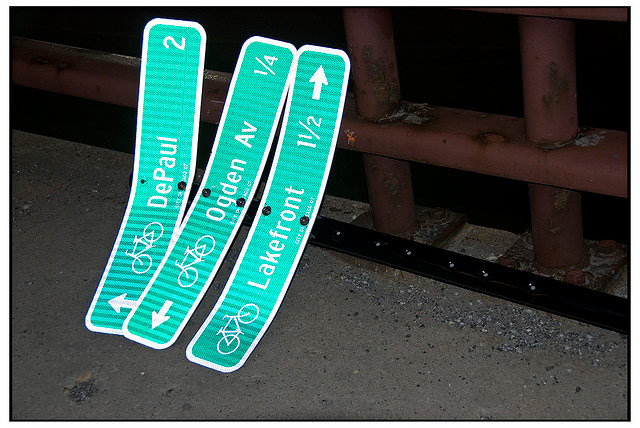
2011_10_16_bikesigns.jpg
"Bike Lanes Optional" [swanksalot]

Who rides bikes in Chicago? With a doubling of two-wheeled commuters since 2000 in the city, there are clearly more bikers all over town. We can’t help but notice an uptick in pedal pushers around the Chicagoist Bronzeville bureau, yet the area has woeful bike access with weird concrete islands reaching into main thoroughfares like 47th Street.
But if you read today’s Chicago News Cooperative article in the New York Times, it would seem that bikes are unique to the Loop and North Side where the City is spending millions on infrastructure for two-wheelers. One protected bike lane on 18th Street is the only project slated for a lower income neighborhood*. Steven Vance of GridChicago expressed concern about the process to the Coop:

“There’s been zero public outreach on where the bike lanes should go.”
We are fans of the City’s effort to fight congestion by making Chicago bike friendlier. Bike sharing and protected bike lanes are great (and represent a big step up from just painting bike lane lines over miles and miles of street). But as the economy continues to tank, bikes are likely to become even more important transportation options all over the City and the investment should make that option easier for all Chicagoans.


UPDATE:
The New York Times offered the following correction related to the story referenced in this post (10/23)

An article last Sunday about Mayor Rahm Emanuel’s $150 million plan to make Chicago “the bike-friendliest city” in the United States incorrectly stated that a protected bike lane to be built on 18th Street is the only biking-related project slated for lower-income areas. Several blocks of another protected bike lane, to be built on Jackson Avenue west of the city’s Loop, and sections of the Bloomingdale Trail, a two-and-a-half-long park to be built on an abandoned rail line from Wicker Park to Humboldt Park, will also be in low-income areas.

Contact the author of this article or email tips@chicagoist.com with further questions, comments or tips.

Comments [rss]

  • John Greenfield here, Steven Vance's blogging partner at
    GridChicago.com.

    Unfortunately, your Chicagoist post helps spread the misinformation in David Lepeska's article.

    It's true that City Hall has neglected Chicago's low-income neighborhoods in the past, more bike lanes were striped on the North Side than the South Side under the previous administration, and it will be important to ensure that the new bike facilities are distributed fairly across the city.

    But Lepeska's article has several incorrect or misleading statements. In fact the bike plan is not biased and there is no backlash, but this poorly researched article generates confusion that could create one.

    "Mr. Emanuel's initial plan is drawing complaints about an inequitable distribution of the investment." Misleading. Lepeska only quotes one Chicagoan, Oboi Reed (a great guy, by the way), who expresses
    concern about the potential for geographic inequity. Steven Vance did
    question the first few protected bike lane locations, but not because he thought they overlooked poor neighborhoods. He just thought the lanes would be more useful on other streets.
     
    "The Chicago Department of Transportation’s $18 million bike share program is to launch next summer with 3,000 bicycles and 300 rental stations–mostly in the central business district and on the North Side." False. Locations have not been chosen yet.

    "Thus far, the city’s lower-income areas are slated for just one project: A protected bike lane on 18th street" False. So far the city has built or announced only four of the locations for the 100 miles of protected bike lanes. Two of these, 18th Street (Canal to Clinton) and Jackson Boulevard (Western to Halsted) serve low-income areas. Stony Island Avenue and Blue Island Avenue, in low-income South Side areas, have also been discussed as potential locations. The rest of the lane locations have not been determined yet, and there will be community input meetings to help choose future locations - a fact that Lepeska neglected to mention.

    The Bloomingdale Trail will serve largely low-income Humboldt Park and Logan Square. So out of the six projects whose locations have been announced (Bloomingdale, Navy Pier Flyover, 4 protected bike lanes), half of them serve low-income neighborhoods.

    In reality, dozens of miles of protected bike lanes and hundreds of bike share vehicles will go to underserved communities, especially if the residents show up to the community meetings to voice their support for these facilities.

  • Since the development of University Village along Halsted, the area from 18th to Roosevelt has become increasingly hazardous to cyclists due to on-street parking next to the bike lane.  I definitely agree with Lisa on this.  This section used to be a lot easier for cyclists (except for potholes).

    It would be great if the vast width of King Dr. along McCormick Place was better striped to accommodate cyclists.  This would be an excellent location for a protected bike lane.

    Canal could go from being an okay bike route to a great one with a little bit of help.  Unfortunately, it's been another victim of University Village, and the huge amount of retail development that has followed it.  South of 18th St., it's not bad.  North of 18th, it becomes a congested, chaotic hell, especially around Roosevelt.  I'd love to see it reclaimed as a rideable route.

  • My husband and I ride in from Bridgeport every day. It would be great to see some bike safe improvements either on Canal, Halsted, State, or King. Most of the North/South streets we have to choose from share traffic with trucks and motorists who use them because they can avoid highway congestion and get away with going well over the speed limit. Halsted has issues because it is a narrower street with a lot of parking where cyclists get squeezed into the dooring zone by motorists who try to swerve into the bike lane to get around cars making turns.

  • jmogs

    King Drive is an example of a street that could and should be spectacularly good for biking---it is extremely wide and offers a quick easy route most of the way from Hyde Park to the South Loop. Good call Lisa!

  • Navin_Johnson

    I wonder how they calculate those figures?  There's no citation for it in the article.
    Are commuters only people going to and from the loop?  What about the rest of us commuting around the rest of the city?

  • Doubling of commuters? That's a very conservative estimate.

  • jmogs

    CNC quotes similar numbers to what I've seen the City use:

    "From 2000 to 2009, the percentage of Chicagoans commuting by bike increased from about .5 percent to 1.1 percent. The growth is similar to that seen in smaller industrial cities like Milwaukee, Oakland, and Detroit, but still lags behind Portland, which tops the US with 6 percent commuting by bike."

  • It's possible you're both right, if the total number of commuters has increased. In that case, a doubling of the percentage of commuters who bike would lead to greater than a doubling of the number of commuters who bike. (The reverse would also be true, if the total number of commuters has decreased.)

    I don't know if this is the case, either through data or through anecdotal observation (I didn't bike here in 2000.)

blog comments powered by Disqus

send a tip

tips@chicagoist.com