Quantcast

Talk Of Breed Specific Legislation Renewed After Recent Pitbull Attacks

2012_1_6_pit_bull.jpg
Image Credit: Tommy Territt
The New Year's Day attack of a jogger by two pitbulls at Rainbow Beach has sparked yet another conversation over whether there should be a ban on the breed. 2nd Ward Ald. Robert Fioretti suggested reopening dialogue on banning the breed after the attack that left Joseph Finley critically wounded. Two days after the Rainbow Beach attack, a Streets and Sanitation worker was confronted by a pitbull in an alley while he was emptying garbage. The Streets and San worker wasn't bitten in the incident, but did injure her back. The dog's owner was cited for not restraining his dog and for not having a dog license.
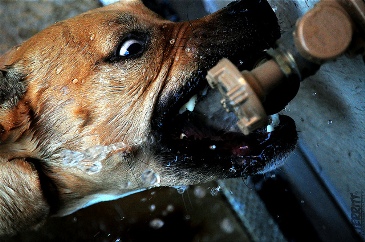
Fioretti, in his call to reconsider a ban on pitbulls, said he heard "nothing but bad" results from pitbull ownership, and that owners of pitbulls involved in attacks might deserve jail time.

Maybe it is something the city council should take a good hard look at,” in terms of what’s happening in our neighborhoods and with the control of these type of animals,” he said.

Since Fioretti has heard "nothing but bad" and we know he occasionally reads Chicagoist, allow your humble editor-in-chief — and onetime pitbull owner — to provide a counterpoint. I've written numerous times that, in my experience, pitbulls are among the sweetest dogs I've ever encountered. I'm not only relying on the years when my dog was alive, but other pitbull owners.

A dog, regardless of the breed, is only as bad as its owner. Veterinarian Dr. David Gonsky told Fox News Chicago that breed specific bans are akin to the "guns don't kill people, people kill people" argument.

Fox News Chicago also talked with Paula Faseas of PAWS Chicago, who explained what exactly makes a dog aggressive.

Faseas said that any dog over 50 pounds can be dangerous, it has to do with the people that own them. Pit bulls are not genetically more dangerous, she said. As a terrier, they do have a chase instinct, but there is no inborn aggression, she said. Instead, aggression comes from the socialization of the dog.

What does reduce aggression in dogs, besides good training, is spaying and neutering, which is something former The Price is Right host Bob Barker has been preaching since the days of black-and-white television. PAWS will spay or neuter a pet for only $25, for people on Medicaid. The City Clerk's office's recently launched dog registration initiative is another way to ensure dog owners are held accountable when their pets attack someone.

Breed specific legislation is looking at the forest for the trees. Another person who's opposed to breed specific legislation is former White Sox pitcher Mark Buehrle. Buehrle won't be moving his family to Miami-Dade County because of a ban on pitbulls.

"Eighteen-month-old Slater Buehrle is an American Staffordshire Terrier — a type of pit bull — and keeping one is illegal in Miami-Dade.

...

"Miami-Dade’s pit bull ban, enacted in 1989, declared American Staffordshires, Staffordshire Bull Terriers and American Pit Bull Terriers dangerous and outlawed them, along with mixes that display certain of the breeds’ characteristics.

Controversial from start, the ban is under attack by groups fighting breed-specific legislation in Miami-Dade and dozens of other jurisdictions around the country.

One Miami lawmaker is proposing a bill this legislative session that would result in reversing Miami-Dade’s ban on pit bulls.

'It really is breed discrimination,' state Rep. Carlos Trujillo said of current law, 'and it ends up with people lying, or people just killing these dogs.'

"Breed advocates say that irresponsible, sometimes abusive humans are to blame when pit bulls turn vicious because the dogs are friendly and loyal by nature.

"Breed foes say that pit bulls kill or maim more people than any other type of dog. In statistics just released, DogsBite.org, a national dog bite victims’ group, said that pits were responsible for 22 of the 31 fatal dog attacks in the United States in 2011, 'despite only comprising about 5 percent of the total U.S. dog population.’

"But Mark Buehrle believes 'it’s kind of ridiculous that because of the way a dog looks, people will ban it. Every kind of dog has good and bad, and that depends on the handlers. If you leave a dog outside all the time, it’ll be crazy. Slater would never do anything harmful.'

"Mark Buehrle grew up with cats, rabbits and fish, but got his first dog with Jamie. They married in 2005 and are spokespeople for Utah-based Best Friends Animal Society, which accepted 22 of Philadelphia Eagles quarterback Michael Vick’s pit bulls."

I agree with Fioretti that abusive and neglectful dog owners should be held accountable for the actions of their pets, if not have their pets removed from their custody. But banning a breed isn't the answer.

Contact the author of this article or email tips@chicagoist.com with further questions, comments or tips.

Comments [rss]

  • Dan

    BSL just does not work, regardless of whether or not you think Pit Bulls are the evilest life form on the planet.

    VERY COSTLY TO IMPLEMENT
    Breed-discriminatory laws are impractical and expensive and do nothing to enhance public safety. If a canine profiling ordinance is enacted, the government has the burden of proof, which means that they have to prove the dog is of a certain heritage. For unregistered dogs or for dogs of unknown origin, this is problematic. For criminal measures, the government must prove that the dog in question is of a certain origin beyond a reasonable doubt. If there are civil penalties, the government has the burden of proving that the canine is of a certain heritage by a preponderance of evidence; and recover of significant monetary damages is rare to offset the burden. The states of Tennessee and New Mexico issued fiscal reports on financial impact breed specific legislation. Those reports are an excellent illustration of the tremendous financial impact and strain BSL has on communities.

    THEY JUST DON'T WORK
    There is mounting evidence evolving through numerous studies that show breed-discriminatory laws are not rationally related to public safety. Studies from the United Kingdom, Spain and Germany have determined that bites do not decrease with the implementation of breed restrictions. You can find links to many of these studies on the Best Friends’ Pit Bull Initiative website. In the United States, Topeka, Toledo and Cleveland recently repealed their breed-discriminatory ordinances not only because they were expensive (#1), but because they were also ineffective. In fact, on the other side of the coin, there is no compelling information or studies that exist anywhere in the world  that indicate BSL slows and/or prevents dogs attacks.

    BREED IDENTIFICATION
    Properly identifying an animal's breed visually is problematic at best. Pit Bulls are perhaps the best example of this confusion. Try Googling "find the Pit Bull" to better understand how near-impossible it is to reliably identify this breed visually with high accuracy. Most animal control and/or law enforcement officers are not able to identify specific breeds of dogs with any degree of accuracy because the commonly stated physical characteristics are similar in many breeds. Breed bans carry with them too much potential for arbitrary or improper enforcement:  inaccurate breed identification by officials and difficulty enforcing breed bans against mixed-breed. Because breed identification by animal control officers is subjective and/or
    arbitrary, it opens the city to liability and litigation issues in the
    event of mistaken identification.

    THE REAL ISSUE
    Restricting breeds of dogs does not address the real issue of irresponsible owners.Only when such owners are held accountable for the actions of their dogs, will adverse dog incidents be reduced. Because breed specific legislation fails to address irresponsible dog owners, many areas that have enacted breed regulations have actually experienced an increase in dog bite/attack incidents of the dog breeds NOT covered by the breed specific law. Owners should be held accountable in the judicial system for the actions of their dogs, not the other way around.  Only then will you see owners committed to providing the proper training, care socialization and supervision that every dog requires - regardless of breed.

    CITING STATISTICS
    Proponents of breed specific legislation routinely rely on the Center
    for Disease Control (CDC) report to support their arguments in favor of
    breed bans. However, it should be noted that information contained in
    the CDC report was gathered via media outlets only (!) thus rendering it an unreliable source to base legislative decisions regarding animal
    control.  It is NOT based on statistics, and the CDC has acknowledged this fact by beginning the report with a similar statement.  For an excellent summary of the flaws of the CDC report, please visit www.understand-a-bull.com.The CDC has stated that their data is inaccurate and not supported by any scientific evidence. Their data was based on newspaper articles and has been found to be unsubstantiated (for an expanded understanding of just how the media affects and sensationalizes data and perception, read The Pit Bull Placebo).  Moreover, the CDC no longer makes reference to breed in their data and has indicated that others should do likewise.
    According to the CDC and the American Veterinary Medical Association (AVMA) there is no individual breed of dog that is responsible for a greater number of bites.  In fact, both respected organizations support responsible dog ownership as the key factor in reducing dog bites. An effective solution is not to make more laws that punish responsible owners and entire breeds, but to enforce existing leash laws and enact generic dangerous dog laws that are not breed specific and punish the irresponsible owners.

  • Chicagoist02

    "Marquis Edwards, 17, son of the defendant, said he had the job of caring for the pets on a daily basis.
    Edwards, who said the dogs were “very trained,” said he had no indication that the neighborhood children were afraid of the dogs. 
    “They played with the dogs,” Edwards said. “They knew the dogs very well.
    “I was never told they were scared of the dogs,” Edwards said. “Why wouldn’t they tell me or my mom?”
     When asked whether he was surprised about the dogs’ attack, Edwards said he was “more than surprised.” 
    “I guess she triggered something to make them act that way,” said Edwards, who broke up when he saw a poster-sized photograph of one of his dogs, dead and bloody. “She’s been around the dogs before.”
     
    Erin Ingram - 10 yrs old lost her arm to these dogs (casee is in news today); Nick Foley -11 yr old nearly lost both of his arms along with a weakened leg; pits that were not abused, licensed and owned in the burbs almost 8 yrs ago.  
     
    I was bit as a kid twice unprovoked - went to the emergency room AND went home that day with no scars left.  IMO, THAT is the difference.  Yes, there were GSDs and Dobies that were popular; then Rottweilers - but no one owned them in the neighborhood.  My dad did not want that type of dog - too much risk. Flash forward and since the 90s, pits have become THE dog of choice everywhere,.
     
    All with no respect to what they were bred to do.  Doggie racism  is soooo bad.  Well.. I don't believe bans will work  - but I do bleieve insurance hikes and lack of allowing any dogs anywhere due to pitbulls will be on the horizon.  Other dog owners can thank the "my dog is just like a Golden" attitude in many of the modern pitbull owners.

  • fergmelk

    Understand I don't think my dog is "just like a golden."  My dog is very different than a golden.  He is more even tempered, more human-attention-seeking, and, well, much funnier and young at heart than most (adult) goldens, labroadors, etc that I've met.  He's almost 5 and still chases his tail, for chrissake. 

    But, like any animal, he has his own "personality" and thus his own limitations.  I, as a loving and responsible owner, respect them.

    I was bit as a 4 year old by a pit.  and it was provoked.  I was trying to ride a dog I didn't know like a horse.  I can't blame the dog.  But my mom was dead-set against pits my entire childhood as a result.  Until I convinced her 25 years later to meet one and rescue it.  Even she is sold now. 

  • American Veterinary Medical Association Reports
    American Veterinary Medical Reports
    "Statistics on fatalities and injuries caused by dogs cannot be
    responsibly used to document the “dangerousness” of a particular breed,
    relative to other breeds, for several reasons. First, a dog’s tendency
    to bite depends on at least 5 interacting factors: heredity, early
    experience, later socialization and training, health(medical and
    behavioral), and victim behavior.Second, there is no reliable way to
    identify the number of dogs of a particular breed in the canine
    population at any given time (eg, 10 attacks by Doberman Pinschers
    relative to a total population of 10 dogs implies a different risk than
    10 attacks by Labrador Retrievers relative to a population of 1,000
    dogs). not consider multiple incidents caused by a single animal.
    Fourth, breed is often identified by individuals who are not familiar
    with breed characteristics and who commonly identify dogs of mixed
    ancestry as if by individuals they were purebreds. Fifth, the popularity
    of breeds changes over time, making comparison of breed-specific bite
    rates unreliable. (pg 5 Dog bite prevention, A community approach)"

    CDC-Dog Bite:Facts
    CDC
    "A CDC study on fatal dog bites lists the breeds involved in fatal
    attacks over 20 years (Breeds of dogs involved in fatal human attacks in
    the United States between 1979 and 1998 Adobe PDF file). It does not
    identify specific breeds that are most likely to bite or kill, and thus
    is not appropriate for policy-making decisions related to the topic.
    Each year, 4.7 million Americans are bitten by dogs. These bites result
    in approximately 16 fatalities; about 0.0002 percent of the total number
    of people bitten. These relatively few fatalities offer the only
    available information about breeds involved in dog bites. There is
    currently no accurate way to identify the number of dogs of a particular
    breed, and consequently no measure to determine which breeds are more
    likely to bite or kill. "

    The Humane Society of the United States: Dangerous Dogs and BSL
    Humane Society

    "The HSUS opposes legislation aimed at eradicating or strictly
    regulating dogs based solely on their breed for a number of reasons.
    Breed Specific Legislation (BSL) is a common first approach that many
    communities take. Thankfully, once research is conducted most community
    leaders correctly realize that BSL won't solve the problems they face
    with dangerous dogs. Restrictions placed on a specific breed fail to
    address the larger problems of abuse, aggression training, and
    irresponsible dog ownership. Again, breed alone is not an adequate
    indicator of a dog's propensity to bite. Rather, a dog's tendency to
    bite is a product of several factors, including but not limited to:

    * Early socialization, or lack thereof, of the dog to people.
    * Sound obedience training for recognition of where he or she "fits"
    with regard to dominance and people, or mistraining for fighting or
    increased aggression.
    * Genetic makeup, including breed and strains within a breed.
    * Quality of care and supervision by the owner (is the dog part of the family or is she kept chained outside?).
    * Current levels of socialization of the dog with his or her human family.
    * Behavior of the victim.
    * Whether the dog has been spayed or neutered."
     

  • E M

    My neighbors: lovely, middle-class, well-educated, even-tempered yuppies, rescued a pit bull mix. This dog, at every opportunity presented, attempts to rip the larynx out of my own small dog's throat. Nearly succeeded on one bloody occasion. He's a heat-seeking missile. Our doors are at most 3' apart, so avoiding this dog is simply impossible. While pit bull lovers can cling to the notion that it's never the dog, it's the terrible owner, nevertheless animals pre-programmed with a bloodthirst are sharing the streets with us, which - like all things - is not a problem for you until it's a REAL problem for you... 

  • EM,

    That is one dog out of millions, but you are judging all of them? Sure, there are other pit bulls like you describe, but all breeds have dogs like that. My pit bulls are around other dogs on a daily basis, and my pit bulls aren't aggressive. Don't judge an entire breed from you one dog experience, because I got you proven wrong with all of my dogs. You have a dog, so you should really ask your vet the next time you see him or her. They'll correct your bad judgement. 

  • fergmelk

    As with many other terrier and hound breeds (including boxers, pointers, jack russells, vizslas, beagles, labradors/retrievers, I could go on)  who were bred for hunting, some pits still have a high prey drive for small animals (squirrels, rats, cats, birds, even small/toy breed dogs). 

    Justine has already pointed out:  that does NOT make them "pre-programmed with bloodthirst" for people. 

    Dogs react to people based on the feedback they get from both their owner and the people they're encountering.  If they sense anxiety/apprehension from *either* party, they *will* react to it. 

  • furytrader

    The Cairn Terrier I had growing up (the ugliest dog in the world but the most loyal too) would go absolutely *batshit* when it came across a bigger dog - would try to tear it to pieces, no matter how big it was.  We got him when he was 2-3 years old, and this was the way he came.

  • A lot of dogs are dog aggressive, not just pit bulls. And a dog being dog aggressive does not make it vicious. I've known many a dog aggressive dog that were the sweetest, most compliant dogs around people, but couldn't stand to be around other dogs. It's called SOCIALIZATION, and sadly, most people don't bother to try and socialize their dogs until they realize the mistake, which, most of the time, is far too late to try.

  • fergmelk

    Many years ago, I rescued a pit that was used as a bait dog, abused and neglected for the first 6-8 months of her life.  When I took her in, she weighed only 15 lbs and had broken ribs, the tips of her ears were covered in fly strike (her ears were basically being eaten by flies), she had abrasions and patches of fur missing from around her neck where she'd been tied/chained to a tree in the back yard she eventually escaped from, etc.

    She eventually grew to be 45 lbs, and she was the SWEETEST dog I've ever known (though, admittedly, a little dumb).  Some of you may have even met her at Double Door as she used to work in the box office with me on Saturdays.  ;)  And when my son was born, she was the most tolerant of any of my dogs to infant and toddler tugging, horseback riding, hitting, etc.  She would sit next to or curl up around him on the sofa to protect and babysit him. 

    *THIS* is an example of a dog that someone tried to "turn bad."  With the right interventions and treatment, she was an excellent family companion.  Not all mistreated dogs (pit or any other breed) can be rehabilitated in that manner, but MY GOD people, I've never seen a pit or any other dog "snap" and attack without a behavior first triggering the attack.  It may be unexpected to the owner and/or the victim in the moment, but any time I've been bitten by a dog (and I've been bitten by a few, a couple were really bad and involved hospital visits), I can *always* in retrospect tell you what *I* did that triggered the response from the dog.

    I do not hesitate to have pits in my home as companions, and I think that Fioretti (who has proposed this before) and Ginger Rugai might be a little myopic in their evaluation of the breed.  They're welcome to my home to meet my dog anytime.

  • ChicagoD

    Man, I remember when we had that Irish Setter and we turned him bad. He would lunge and growl . . . oh wait. That never happened. I remember that lab we had . . . oops . . . ditto. Ultimately people are responsible for the bad acts of their animals, but we should not pretend that breeds don't (generally) have different temperaments. 

  • Brianna Reynolds

    I had a lab growing up that we treated like gold, she attacked me everytime I tried to take something from her that she wasn't supposed to have, to the point where I often had to lock myself in another room to get away from her. I have a pit bull, that was rescued, and I can stick my hand down his throat whether to remove a chicken bone that he found in the garbage, or to take his toy out of his mouth mid play, without a single concern. I can do this with him, and so could any other person that walks up to him. So if the "generally different" temperment that you speak of, is that of pit bulls being LESS human aggressive than other dogs, than I agree with you. If you want to try and say that a pit bull is more likely to be "turned bad" than other dogs, I urge you to educate yourself, and spend time around pit bulls. You can find hundreds of them in any given shelter, in any area. And each and every one of them would be more than happy to change your mind. But please, do not spread ignorance, especially about a dog that was once known as an American Hero, used as a nanny dog, farm dog, a companion to Helen Keller, and a loyal protector of many more.

  • When I was four, I was bitten in the face by my family's border collie. I still have the scar on the bridge of my nose. My family did not mistreat this dog. It just decided to snap one day.

    That said, I think it's wrong to keep any large dog in the dense, confining environment of the city. Dogs need space that's just not available here. We need to remember that no matter how much we love them, they're still animals.

  • You can argue your statement against the results found by the American Temperament Test Society's (http://atts.org/) and see the results under Breed Statistics. You might notice the American Pit Bull Terrier "temperament" is ranked at 86%, above goldens, cocker spaniels, and collies to name just a few.

  • The only dog I've ever been bitten by is a golden retriever. And if you want to talk temperment, go look at the pit bulls that survived Michael Vick. At least a half a dozen of them are licensed therapy dogs.

  • It hurts me to my core that because of the negligence of others, that I have to worry about the dog I love being banned in the city I have lived in my entire life. I am all for stiffer penalties for bad dog owners, buy I cannot stomach the city looking at enacting BSL laws. 

blog comments powered by Disqus

send a tip

tips@chicagoist.com