Got a Tip?
tips @ chicagoist
About Chicagoist

Chicagoist is a website about Chicago. More

Editor: Margaret Lyons
Publisher: Gothamist

About | Advertising | Archive | Contact | Mobile | RSS | Staff

Categories
Favorites
Contribute

Latest tip:

What is the "attic club" on the south west corner of Wabansia? It is on the national register of [more]


Latest link:


Latest Photo:


Recent Comments
Ask Chicagoist
Tshirts
Subscribe
Use an RSS reader to stay up to date with the latest news and posts from Chicagoist.

July 17, 2007

WLUW: WTF?

After we saw an anonymous tip on our sidebar saying that WLUW (88.7 FM) would no longer exist in its current form, we were filled with a sense of dread. How? Why? More importantly, was this really true? We called Shawn Campbell, Program Director, to see what was up. She confirmed that the gist of the tip was true, but told us that the information had been leaked to Feder before WLUW and WBEZ had a chance to talk to their staff (no one from management had done this). They definitely wanted to do so before making a public comment, and Shawn remarked on the situation, "We wanted to wait until after Pitchfork so everyone's weekend wouldn't be ruined." Fair enough. Unfortunately, that privilege had been stolen by someone already.
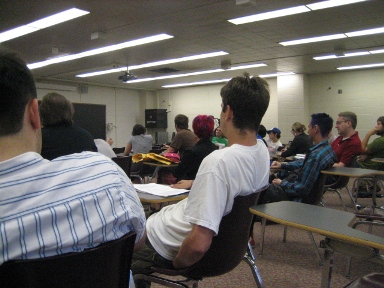
2007_07wluwmeeting.jpgHowever, when we went over to the station last night, we heard there was a meeting with the WBEZ higher-ups (Torey Malatia, General Manager of WBEZ; Ron Jones, Program Director; Daniel Ash, Vice President, Strategic Communications) and the staff to answer any questions they might have. We have done one or two airshifts at WLUW and have helped out with the pledge drive on several occasions, so we sat right down for the details.

First and foremost, we were entirely pleased that the voices from WBEZ were completely forthright, transparent and willing to answer all the staff questions. So much so that we had to leave before the then two-hour meeting was over. The meeting started off with Shawn Campbell and Craig Kois (Station Manager) giving a few personal remarks. It was soon to be revealed that they would no longer have positions with the station, which came as a shock and visibly angered and saddened the staff deeply.

Kois started by saying "the passion [they have for independent community radio] was challenged by Loyola [five years ago], and these fine folks from WBEZ saved our asses." Shawn was also quick to note that "they [WBEZ] did everything they could to prevent this from happening, and they've been with us every step of the way." It was an exact opposite from a meeting held with the staff five years ago when they were informed WBEZ was coming on board to start to help run the show. At that time, people were convinced WBEZ was going to be a repeater for their 91.5 signal or that they were interested in coming in and completely changing the station. Gratefully that was not true, and now WBEZ was now perceived as the station's biggest friend and ally. In fact, according to Malatia, the reason they got involved in the first place was because they believe in community radio and invested in WLUW in order to "preserve an art form and important voice that is largely missing from the dial."

Hear more about the details of the meeting after the jump. ...

Malatia stepped up and laid out the details of what had happened and what was currently going on. When 'BEZ came on to the scene five years ago, they had made a five-year operating agreement with Loyola University. If it went to seven years, it was renewable for another seven, but there was also a mutual escape clause that either party could enact, giving the other party nine months to transition. That was what Loyola was doing; they were exercising the right to take back complete control of the station at any time during the agreement. They hold the license to broadcast on the 88.7 signal, and decided they wanted to be in control of it.

In our minds, it was ironic (or very calculated?) that the University would decide they wanted their station back after WLUW had its best and most successful fundraising year. Each year, the station had grown in listenership and its ability to work toward self-sufficiency. And WBEZ had worked hard to maintain financial independence from Loyola, seeing to it that WLUW was truly a community station, free from the constraints of the University. To help facilitate this, they set up a community council to help contribute to and watchdog the station, and they created a membership database to keep track of all the supporters.

Yet, last Wednesday found Malatia on a conference call indicating that the re-claiming of the station by the University would officially happen. There had been rumors and rumblings about such things for quite some time, but the absolute, final, 100 percent confirmation was handed down last Thursday. All throughout the staff meeting, Malatia and Jones tried to offer cold comfort and made a plea that the station would continue at its high level of professionalism and quality until the very last second, that second being in June of 2008. Loyola could technically pull the plug on the station any time from here on out, but it seems unlikely. However, any ideas about potential future programming or format was merely speculation on WBEZ's part. They had no concrete details or idea what the University might do in a year.
2007_07wluwlogo.jpgDespite not knowing what the future programming intent of the University was, Malatia stressed the point that WBEZ was going to continue to try and increase the value of WLUW and make the service even stronger than it has been in an effort to further deepen their relation with the community. The question of why no one from the University was at the meeting was raised, and it was merely because Malatia, et al wanted to just tell the staff what was going on and answer their questions first . They were happy to request a meeting on the staff's behalf, but they also couldn't guarantee the University's compliance, either.

Since Campbell and Kois would no longer be at the station, WBEZ would bring in someone from their staff, Christina Stevens, to oversee the operation in the interim. The staff was reluctant to accept this change and wanted to know why Craig and Shawn couldn't also stay until the last possible minute. There were two factors in this decision which seemed to come down to the fact that since WBEZ would no longer be able to fundraise (completely unethical if they don't run the station), they could no longer afford to staff two full-time positions. Also, it was made clear that being around for the end of what Shawn and Craig had created wouldn't have been the most rewarding experience for them. They seemed as okay with the decision as anyone could be facing such a huge loss in their lives.

The next set of questions got back to the format issue -- what was the University's intent in taking the station back? Again, everything was complete speculation; there had been no discussion with Loyola about the potential future of the station. Loyola was opening a new School of Communication, and there was thought that maybe they would use the station as a bright shiny jewel for that school. Maybe they'd broadcast student events or have broadcasts of sporting events. There was no way to tell, for the University hadn't given an inkling to their future plans. A few staffers expressed concern that it would become a learning lab for the students or that a school that claimed interest in serving social justice but who took over a radio station would radically alter programming.

There were lots of emotional statements from staff, and not just one person filled with tears and outrage. The idea that students weren't being served seemed ludicrous, since no student that had come to the station to volunteer had ever been turned away and WLUW has the most students working at it of any station in a unversity setting, save from WNUR -- their students from the Medill School of Journalism were required to work at the station as part of their coursework.

There was never any request that the staff not talk about this in their communities, on blogs, with their friends and exhibit a passion for the station. It was cautioned that it would be the best way to service and honor their listeners if they continued on the air as much as they could, business as usual, professional and respectful, and not go on air blasting the University for their decision. (That's our job.) Torey urged the staff to continue doing "the good, solid, great work" they had been doing to make "the best effort to show that [the station] is lasting, important and part of the quality of life for its listeners." He made it clear that each staffer needed to decide for themselves if they would stay around for the last year, but he suggested again that it might be worthwhile to enjoy the station while it was still in its current form; he said that if they enjoy doing the work and people enjoy listening to it, it might well serve them to "rage against the dying of the light." Daniel Ash did suggest that if people were to write letters to the University, they focus on their personal experiences with the station and how much the service means to them. At this point, continuing on with the station and striving to make it the best station possible ends to be a "no-lose proposition -- the listeners benefit no matter what," Malatia said.
2007_07wluw.jpgMalatia also recalled the beginning of the relationship with WLUW and how WBEZ didn't come into the agreement knowing they wanted to keep Shawn and Craig, but how they realized that all the energy that was created around and about them made them realize they were perfect for the job. He told the students that Christina Stevens would be meeting with them soon and would not make "wholesale changes" to the station. Many opinions were expressed giving their gratitude, respect and admiration for what Kois and Campbell have provided to the station for these past five years in particular. Kois said, "Since we have started community radio, there has always been opposition to what we have done, and every time we worked harder to do what we have done. The greatest tribute to Shawn and me is to continue the work we started. If you do this, you keep your options open, but if you self-destruct, you don't have an option." Malatia also reminded the staff that legally, Loyola had a legal obligation to serve the public interest and that the radio spectrum didn't know campus boundaries.

So. That's about it -- if you've made it this far, you must really care about WLUW. We think this move sucks. One staffer said, "It feels like I got fired, but my job called my mom to tell me." Our analogy is much harsher. For us it's like a parent who gave their child up for adopton because they just couldn't handle it anymore. And then once the adoptive parents raised the child and made her a great success, the parent came back and said, "I know I left you cause I was an alcoholic and couldn't handle you, but now that you look so good and act so incredibly well, I'm coming back to claim you for my own." Except for in adoption cases, the biological parent/s can't just decide to take their child back all willy-nilly.

As for now, the fate of the very successful WLUW record fair is left hanging in the balance, since it was a fundraiser for the station. They have an upcoming show scheduled for Aug 10 at Double Door (looks sweet -- Canasta, May or May Not, Plane and Driftless Pony Club), that will have to be restructured to benefit another charity or cause, due to the fact that the station can no longer fundraise.

WBEZ's new station Vocalo was mentioned over the course of the discussion as a place that was created out of what 'BEZ had learned from the sensibilities of WLUW. We wanted to hear them offer up more solid guarantees that they would transition some of the people from WLUW to Vocalo. Right now, the station seems to be struggling to find a voice and some consistency, and it would be nice to see people from WLUW who have prior on-air and production experience come on board to even out Vocalo's sound and vision. However, nothing was really said toward that direction.

We are disheartened at the idea of WLUW changing or disappearing in the next year. We think it's shortsighted of Loyola University to suggest making changes to what is a successful, thriving, important member of its community and a true voice of independent music, progressive causes and specialty shows. We can only pray that the University sees what a gem they have in the current format and structure and does little, if nothing, to change it when they resume operations. There's nothing stopping any student from participating, and until now Loyola hasn't even pursued the wonderful station as a recruiting resource, despite their current eagerness to reclaim the station for the student body and curriculum.

Losing Campbell and Kois is a huge blow to the station, and while we believe the men at WBEZ in that Christina Stevens will be there to help in any way possible, it still just won't be the same. We're still reeling with the announcements and we aren't sure what the best course of action is regarding the matter. However, if you wish to write a letter of support (better than lambasting the University, all told), here's the information for the Office of the President. We're not sure that's the best place to start, but we're a fan of going to the top.

That's what we know for now. It's a sad day, to be sure.

Classroom photo courtesy of the author, second WLUW logo courtesy of brewinbeagle.


Email This Entry


Advertisement: Chicagoist Continues Below!

Comments (28)

Unbelievably great piece Jocelyn!


As a supporter of WLUW and a regular listener to The Razor & Di Show (the best independent rock show on the air), I am disheartened by the decision of Loyola to re-take the station. It begs the question, what happens if they run the station down to the point where they don't want it again? Will another group of committed individuals have to roll up their sleeves and resurect it all over again? I hope WLUW remains to be an independent voice on the radio spectrum, but I guess we'll have to wait and see.


I have followed the unfolding WLUW - Loyola - WBEZ saga for years now and it has always been difficult to understand Loyola's motivations in all of it. If they want to take the credit for running a great independent radio station, why dismantle a great station and start over? If Loyola has some other big plan for what they want to do with the frequency and license, they should make it known soon because this is a bad public relations move. It just makes Loyola look like a nasty bully, bent on getting the final say. They have put all kinds of banners up and down Sheridan, and billboards elsewhere, trying to sell the quality of student life there, and yet they are going to destroy of the best assets the campus has.


This is really sad.


This is really freaking sad. I saw that comment and googled it, and couldn't find any information, so I went back to having fun during Pitchfork. Thank you so much for writing this really detailed and awesome post that explained a lot. I'll be linking it, Thanks Jocelyn.


Great piece, Jocelyn. I'm hesitant to bash Loyola and assume the worst... yet. Hopefully they can be as transparent about their motivations as Malatia et al. have been about the future of their involvement with WLUW. Hopefully that transparency will come soon.


I was a Loyola student and (crappy) on-air DJ during the WBEZ transition and was glad when things continued basically as-is. I even thought the fund-raising sort of united everyone and made them really care about what WLUW offered.

Hopefully things won't change too much for the listeners, but I'm sad to hear Shawn and Craig are leaving. Craig was a great teacher and I really enjoyed the classes I took with him, and no one cared as much about WLUW as Shawn.

Now I wish I'd bought a T-shirt at Pitchfork!


Thanks so much to everyone for the kind words. It's an extremely hard time for us, and all the great things people have to say about the station really do let me know we've made a difference. We love you guys, and we're going to look into some other possibilities (be sure to call your Congress members and ask them to support HR 2808 and SR 1675, the Local Community Radio Act, which would allow new low power FM licenses in urban areas like Chicago). You've not heard the last of us.

Stop in, and I'll be happy to give you a goodbye t-shirt.


Wow, this is deja vu from when the Loyola/BEZ fiasco first started. With all due respect to Shawn and Craig personally, to me professionally it never made sense for a fledging volunteer-powered 100-watt station to be burdened financially by the salaries of two highly experienced full-time employees. I'm sorry, I just don't see how that ever could work out in the long term. No one wants to see their friend lose a job, but in the end you've got to look at the big picture and ask what's best for the organization as a whole. Saying WLUW will "no longer exist in its current form" is a bit overly dramatic at this point. There's no reason that the station still can't thrive in its current format with a mix of talented students and highly educated communications professors at the helm.

That being said, I do think we all should make our voice known to Loyola that WLUW is an invaluable resource and a change in format would be a huge loss to the community. As sad as I'm sure a lot of people are to see Shawn and Craig go, at the same time this also could be a really great opportunity for the station if everyone (students, volunteers and university staff) works together on a focused commitment to education and service to the community. At the very least, we can at least hope this means a drastic reduction in the amount of time devoted to pledge drives. (hopefully that's something we can all agree on)

-brad knutson
former WLUW volunteer


"to me professionally it never made sense for a fledging volunteer-powered 100-watt station to be burdened financially by the salaries of two highly experienced full-time employees. I'm sorry, I just don't see how that ever could work out in the long term."

Well, you're wrong. It was working. WLUW had it's first balanced budget in 2006 and only looked to be doing better in 2007. Listenership was growing and the quality and professionalism of the station has definitely improved in the last five years. If you think Shawn and Craig were pulling in huge salaries with these jobs, seriously, you're living in some fantasy land.

Anyway... in case anyone missed it, there was a Timeout Chicago article about this today:

http://www.timeout.com/chicago/outandabout/?p=2548


This is a great article and puts a solid recap on a lot of what has been said and thought about this transition. however, i dont think that a lot of it has been fair to Loyola, especially since everyone comes mostly from the radio station's point of view.

even considering that loyola is looking to "cash in" on the hard work of the staff and volunteers at WLUW by taking back the station once its financialy independent is very one-sided. i imagine that loyola sees this radio station as an asset to themselves and the community, and always has. it could even be argued that, while in their own financial problems 5 years ago, loyola needed to hand the reigns of control to a better suited radio leader precisely because it was an important community outlet. if the whole school was having financial troubles, how could they serve the community with their radio station?

on the other hand, i dont think that the financial state of the radio station made much of an impact on their decision at all. the truth is, the school is expanding, for their own good and the good of the students and community. they are creating new schools and majors to complement the changing times. inevitably, these majors include journalism, media, and public relations, all of which are heavily aided by having their own radio station.

i think its important also to realize that when loyola and wbez came to this agreement originally, this clause was put there for a reason. loyola knew that the station was an asset, and knew they would need it again. i do not want to belittle the work that everyone has put into making this station amazing, but i think it was forgotten that the whole time, this station was borrowed from loyola.

that said, loyola is full of intelligent, caring people, especially the faculty. if the opinions of the staff and volunteers at wluw are expressed to them in a manner of cooperation and concern for the community, there is no way they will be ignored. change is scary because it could go either way: bad or good. change was fought 5 years ago because of fears that proved to be unfounded. i think if the cumulative energy is put into ensuring that the station remains a beacon to the community and the music lovers it caters to rather than fighting inevitable change, then in time, this change too will be for the best.


The Milwaukee School of Engineering's radio station, WMSE, is /the/ absolute best example of what can happen to a college radio station when the clever deviants who love the station wrestle control of it back from the school.

http://www.wmse.org

Not only is the station entirely self-sufficent, but they've survived for decades, and have actually managed to create an amicable relationship with the campus that they operate out of.

/These/ are the guys that WNUR envy. Even if they are from Milwaukee. I know it's a stretch, requesting that the hipster-that-are in Chicago to actually check into something north of the border that isn't, y'know, Summerfest, Sprecher or Lake Geneva...but 'MSE is /the/ best college/community radio station in the nation, bar none.

Malatia, et al, would be well-advised to speak to Tom Crawford, the current General Manager of WMSE.


while the news of WLUW's transformation is so shocking, i feel that jabs and mentions of WNUR are insignificant. the medill school of journalism does in fact NOT require its students to partake in WNUR, it is entirely a volunteer-based organization, the largest student-run college radio station in the country. i encourage chicagoist writers to research their facts thoroughly so as to not misconstrue the inner-workings of WNUR.

cheers


The faculty adviser of WNUR says Medill students are required to participate in WNUR news.


Typical arrogant behavior on the part of Loyola University. They have always had a paternalistic attitude toward their students, and I see nothing has changed. Sure, they'll make sure you feel "listened to" but in the end they will do exactly what they had planned to do from the beginning.


forgive me for harping on such a trivial detail, but as a medill student, i can assure you that there is no stipulation on the behalf of medill for students to be invovled with NUR. everyone from engineers and math to theater and voice majors take part at the station. the adviser, is misinformed.


“At the very least, we can at least hope this means a drastic reduction in the amount of time devoted to pledge drives. (hopefully that's something we can all agree on)”

With the termination of WBEZ's stake in the operating agreement, it is now illegal for WLUW to fundraise. Loyola will now cover all expenses. This means that the volunteer staff, paid management and programming of WLUW will no longer be accountable to listeners, donors or the community. They will be accountable exclusively to Loyola.

All radio broadcasters, be they to the right or the left of the dial, are mandated by law to serve “in the public interest.” Commercial radio stations interpret the law very broadly. WLUP, for example, feels it is in the public interest to play an AC/DC song every 20 minutes.

Loyola University, as the sole fiscal contributor to WLUW, will be accountable only to themselves for WLUW’s content. They are free to serve the public interest as they see fit. How they will do so remains to be seen, and we are all hoping for the best. But without fundraising, there is only token accountability to the listeners or volunteers. Without fundraising, there are no real consequences for failing to serve the public, or for serving less of the public, or for serving the public less well.


commercial stations usually "serve the public interest" with those late sunday night programs. if you've ever tuned in at 3 in the morning and found your fave station running some weird ass talk show, that's why. it's also why NBC and those guys have those weird public interest shows on sunday mornings. serving the public interest.


don't forget loyola owns the signal, houses and supports the station, its offices and equipment and supplies the license, etc. there would't be a radio station without them. i'm a gigantic fan of WLUW - it's the best station in the city, but demonizing a university for its decisions regarding a station that it has always owned and operated is a bit much. let's hope loyola follows the path that the wluw staff has created the last few years and we all continue to have one heck of a good station to which to listen.


for the record, for the last five years, they have NOT supported the station. that's why WBEZ came on board and helped with fundraising and were on the hook for any deficit between budget and fundraising. they came in and decided to reclaim something that had prospered and flourished in their absence.

also, the quotes from the scott smith article in TOC indicate that they are very interested in using this as a learning tool, which makes me wonder just what they have in mind.


i would say supplying offices, the space, the transmitter, the license and the equipment is pretty big support. wbez didn't pack up a truck and move the 'luw studios to navy pier - they remain in rogers park on the loyola campus in loyola buildings.


The equipment WLUW used already had been purchased. Any new equipment needed over the past five years was purchased by WLUW itself, not Loyola. The space already existed in Damen Hall, which was being emptied out in preparation for getting torn down. WLUW paid phone and other bills. Yes, Loyola provided the space, but they certainly didn't support the station's operation. Listeners did that.


And, as far as the cost of a transmitter?

You can build a transmitter out of an old coffee can. Commander Todd did it with WTPS (look 'em up).

Or are you referring to the FCC license fees, which I thought were finally suspended for low-watt, community/college, non-commercial radio stations?

Or did they just suspend the need for individuals to have a FCC broadcasting license?

I readily admit I could have all this wrong, here - except for the coffee can transmitter. Them's for reals.


WNUR was behind this! I'm calling Joey Greco of "Cheaters!"


you used to have to have a license (i think it was only $10), and i still have mine. but you don't have to have one now. i love that i have one, though.


This article is completely one sided. As a Loyola grad and WLUW alum from the early 90's, WLUW was an invaluable "student learning lab" that launched many professional careers (Susan Carlson from Ch.2, Lou Canelis from CLTV/Ch.7, etc. etc. etc).

Students who pay upwards of $20,000+ per year who are majoring in "Communication" expect hands on/real world experience at Loyola's radio station. The whole independent community radio format DOES NOT serve the tuition paying students who intend to work in the real world media and need real life experience.

The whole idea that the University decided to stop funding the station in the first place is mind blowing.... How many tuition paying communication students did they lose while they "outsourced WLUW".... Loyola has the opportunity to correct a wrong and bring the station back the way it was supposed to be used...for the students to learn real world radio....

TG Class of 92


TG's post above is nonsense. There is nothing about "the community radio format" (which is not a format at all -- it's a philosophy of managing and programming a station to ensure diversity and the inclusion of voices that often go underrepresented) that precludes anyone from getting the experience and training they need to get a job in commercial radio. In fact, a number of those who came through WLUW during the past decade have done just that.

I worked in commercial radio for years before I came to WLUW (including WBBM 780 immediately prior), and worked with everyone who had an interest in getting a job in commercial media to help ensure they were successful. The fact is, everyone who has come through WLUW over the past eight years has been able to tailor their participation to what they want it to be. Some people asked for lots of feedback, help in getting a tape together, assistance in choosing internships, etc. Others just wanted to come in and play some cool records.

One thing we did ask of everyone who came to WLUW, though, was to treat their shows respectfully and professionally, and to always work to improve their performance. The fact is, the only way to get good at being on the radio is to be on the radio, so you certainly heard people who were just starting out on the air. I will defend this philosophy to the mat, and I really resent the ignorant notion that inclusiveness and an openness to lesser-heard viewpoints somehow equals a lack of professionalism or of interest in helping people achieve the goals they wanted to achieve.

And yes, WLUW management was "outsourced" over the past five years...outsourced to Chicago Public Radio (yes, public radio, which actually has seen growth in job opportunities over the past decade, unlike commercial radio, where jobs continue to decline at an alarming pace). Is TG insinuating that the Loyola University faculty somehow has more experience in running a "real world" radio station than WBEZ?

TG shouldn't speak about something he never experienced.


Nonsense? That's laughable. Shawn's post above smacks of arrogance. There is a successful WLUW history pre-1997 or whenever Craig over took the station, Shawn. I'll tell you from personal experience, Loyola University certainly did a great job of running the radio station before C & S ever stepped foot in the door.

So many alumni (yes---actual students who attended Loyola) had the opportunity to work with wonderful Loyola Univ staff members who produced a terrific radio product (High Energy, Energy, Hitline, etc) giving STUDENTS terrific experience. Great People like Jym G. & Wayne M., all under the direction of Prof - Dr. S. Danna who founded WLUW to begin with---developed great talent that you see and hear across Chicago and the entire U.S today. Turn on Ch.2 and Ch.7 to see Lou C. and Susan C. ----both are terrific & both products of Loyola faculty run WLUW. I'm sure they would agree that the faculty run WLUW was

I worked in commercial radio "after" WLUW and also benefited from the Loyola Degree that came along with the WLUW experience. It sure seems to me Loyola has the right to use the radio station that it holds license to for its students like it did pre-1997, I can't believe that someone would call that "nonsense"---it must be political and from what I have read---WLUW has turned into a back biting political operation under the C&S regime, what a shame---that never was the case pre C&S.

Shawn shouldn't speak about something she never experienced----Oh wait, I take that back---that would be arrogant of me if I said that.


"WLUW has the most students working at it of any station in a unversity setting, save from WNUR -- their students from the Medill School of Journalism were required to work at the station as part of their coursework."

As a Medill student and four-year executive board member at WNUR/WNUR News, I'd like to clarify/correct the above statement from the article. WNUR is not affiliated with Medill in any way - it is actually part of the School of Communication. Also, I am not aware of any Medill class that has anything to do with WNUR, much less requires students to take part in it. I have run through Medill's main broadcast coursework and can assure you that I am not aware of any Medill class that utilizes WNUR.

That said, Medill students can of course take part in WNUR, but it is on a strictly volunteer basis.

 
Post a comment (Comment Policy)

2003-2008 Gothamist LLC. All rights reserved. We use MovableType.