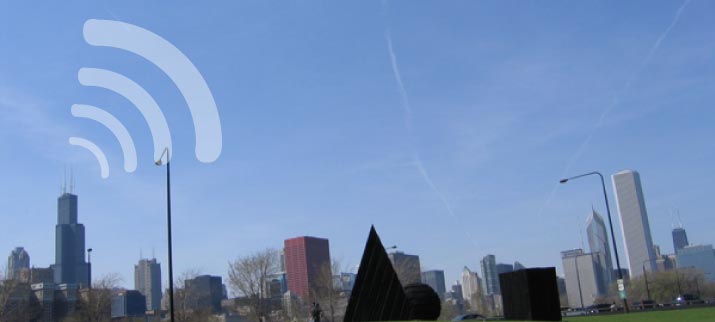
Ah, the best laid plans of politicians and telecoms often go awry. When Chicagoist first heard the possibility that we could soon be bathing in glorious Wi-Fi in the streets of our fair city, we reacted with skepticism. We did dream a time when we could check our e-mail while riding the bus or post while relaxing on the beach. But that was back in 2006.
Unfortunately, for now, we will have to put such lofty goals aside. It just isn't to be. We didn't notice, but apparently the world has changed dramatically since ol' 2006, and the plan just isn't as feasible now. Chicago was slated to be one of the first major cities to roll out municipal wireless internet. The plan would have allowed for Chicago to build the infrastructure and a telecom to administer the service. The goal was to offer the service to subscribers at around $20 a month.
Unfortunately, the question is now, who wants $20 municipal internet? A similar plan was enacted in Lompoc, Calif., where a $2 million municipal internet service resulted in 500 subscribers in an area covering a possible 40,000 people. Earthlink and AT&T, two of the possible providers, were looking for the City of Chicago to practice what they preach and be an "anchor user." Yesterday, it was reported that the negotiations have ended unsuccessfully.
We've always been slightly wary of public Wi-Fi, free or not. For one, despite our jest, technology has changed. Sprint is preparing to roll out a WiMax service that covers a lot more area with a lot less equipment. Also, while not always true, we can usually find Wi-Fi pretty easily. Most coffee shops have it, Chicago libraries have it, some Chicago parks have it, and even Subway has it. The number of possible problems with public internet could take up an entire page, including, but not limited to, security, outages, slowdowns, etc. We can't always count on the CTA, and getting to work is much less important to us that what is happening on the internet.
Our suggestion? Make it free, support it with advertising (for the price of free, we won't complain about advertisements on our computer), and we may use it as a backup to our normal connection.


I'm glad you mentioned WiMax. Municipal wifi is shortsighted given the potential of WiMax. In a few short years, WiMax adapters will be ubiquitous in new hardware and adapters will be "free after rebate".
On a technical note, the number of access points required for municipal wifi to work is insane. I can't get a decent signal in the back half of my small apartment from my own router. For the nerds out there, how could the city think they could handle channel overlapping given the number of APs that they would have to install? It's nuts!
Don't know how Denver did it, but public wifi service downtown there was just fine.
The internet is a passing fad anyway--good riddance.
You are a fool. Good riddance to your retarded butt.
Doppler - I agree completely. At least they axed the project beforing installing a billion routers, only to find out about WiMax *then*.
Frankly, I'm surprised that one of Da Mare's buddies didn't get the chance to put in a billion routers, only to "find out" about WiMax after the fact. And then have to go back and put in new routers. On the City's dime.
WiFi in Chicago? Would be nice if the CTA ran right.
Oh yeah, that's just wishful thinking, I suppose....
There are a lot of people who could benefit from a program like this. I wouldn't put much faith in WiMax they have been talking it up for over 4 years as far as I am concerned it is vaporware. What makes you think Sprint will offer a low priced broadband alternative, furthermore what makes you people think the disadvantaged that this program was designed for will be the first adopters of expensive WiMax cards. If anything we will have to hope that google wins the 700Mhz spectrum if any service like the one proposed is to exist. The problem with this program was it was too broad in its scope the only areas that needed to be served by this were areas where there is a high need for cheap broadband service where dsl is not available ie low income housing areas and business districts where ad support would have been enough to justify an investment like this. Normal residential and industrial zones have zero need for a service like this. Access to the internet for disadvantaged children is a noble cause especially with the shape of our school system so just because you have internet access doesn't mean there is not a place for WiFi in Chicago.